
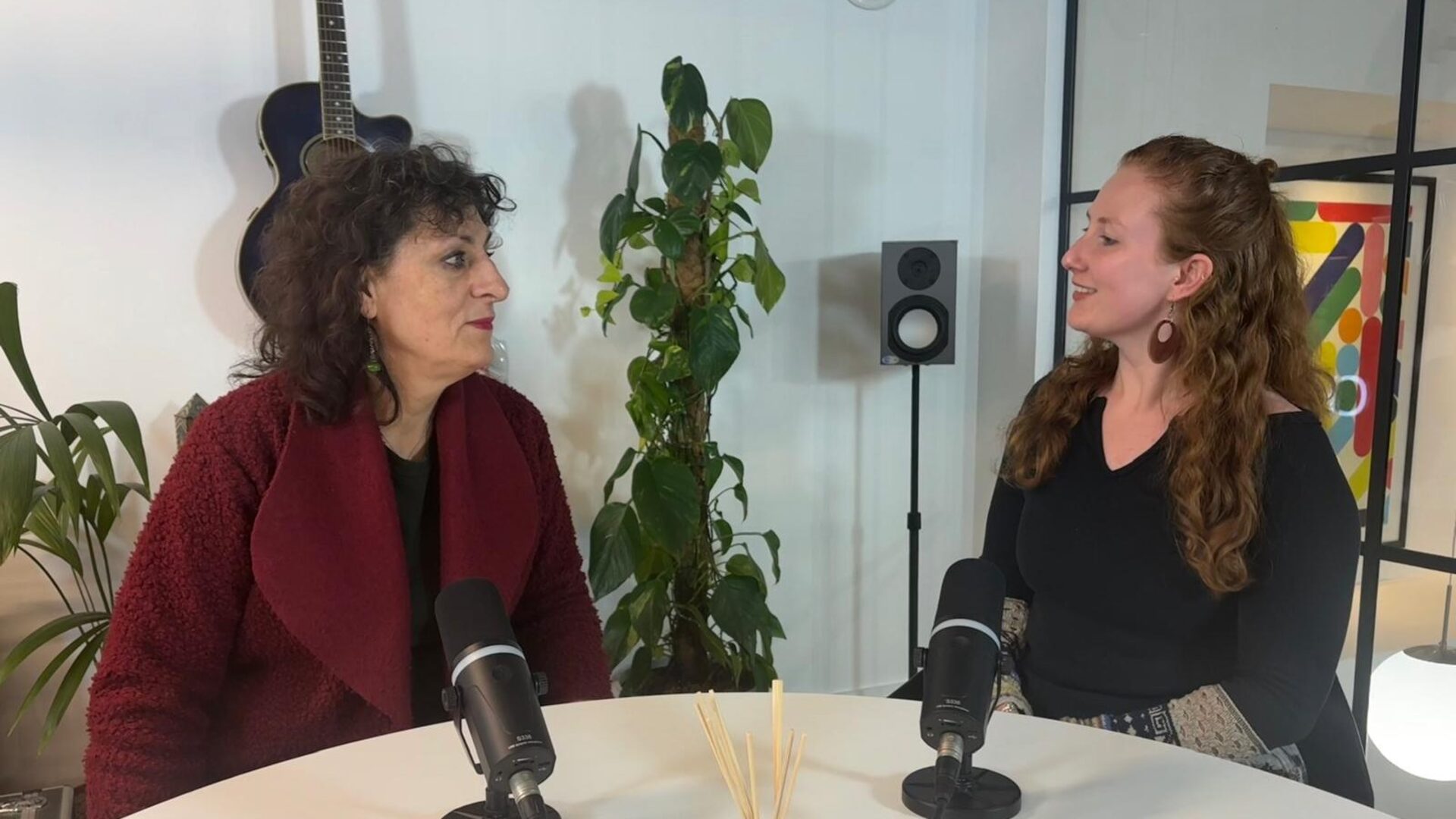
Yoreflix discusses 'Put Away' with filmmaker A D Cooper
Put Away is a short film about a woman confined to a mental hospital for a lifetime, made during lockdown with a crew you could count on two hands. It has since won 17 awards. Its writer-director, A.D. Cooper, teaches screenwriting at the London College of Communication — and, three decades ago, was one of four women who founded the Women's Rugby World Cup. Yoreflix founder Imogen Cooper talks to her about asylums, cake as currency, and refusing to put a script in a drawer.
"If you could go back to any period in history…"
Imogen Cooper: Before we get into the making of Put Away — if you could go back to any period in history, as yourself or as a character, what would it be?
A.D. Cooper: I would like to be a woman in World War One, the 1920s, 1930s, that sort of era. That was when women started to get some kind of parity and progression in their rights. They were no longer their husband's property, and they could actually go out.
An awful lot of women — about a million and a half — were what were called surplus women at the end of World War One, who had no chance of getting a husband. It's harsh, but that was the reality. So they went off and became lawyers and doctors and explorers. They set in train a lot of things that are now quite normal.
Making a film in lockdown, with one actor
IC: Let's talk about Put Away. You pretty much ran the show, didn't you?
ADC: The idea came from the depths of lockdown. What could be worse than having to stay at home with basically a bag over your head? I decided it was being sane in a mental hospital.
I was working on a longer project, so I took one of the characters out of it and made a story about her. There were also very limited funds, so we couldn't afford more than one actor — and a very limited crew, because we filmed just as we were coming out of lockdown. Everyone had to be masked, contained, hand washing. So we kept the crew super small.
IC: When you say small, what's your skeleton crew model?
ADC: Boom operator, sound, gaffer. I think that was it. We purposely didn't let her have any makeup — she's a very beautiful woman, we made her look really dreadful, and she still looks beautiful. So unfair. Then in post we had an editor, a sound designer, a composer and a grader. And I did some of the catering.
IC: I've spoken to quite a few filmmakers now where it's a real write-the-theme-tune, sing-the-theme-tune situation.
ADC: Otherwise you're just waiting for somebody to give you permission. You just get on with it. And people can be bribed with cake. I would ring up post-production houses and say, can you help me, I need a grade, and there isn't really a budget, but I can make you a cake. We don't really work for free. What sort of cake?
IC: Cake has currency.
The real history behind Prudence
IC: How deep did you go into the history of the women who ended up in asylums for their whole lives?
ADC: Quite deep. I found — bizarrely, on Amazon — a report about the mental hospital at Friern Barnet in North London, which is now a very swanky designer flat block. At the time it was one of the biggest mental hospitals for women. The corridors around the place ran to two miles.
It was patriarchal control of women. If you defied your husband, your father, your son, you got put away. If you got pregnant out of wedlock, off you went. If you had Bell's palsy, if you had Down's syndrome, if you were in any way a suffragette, away you went. You only needed two doctors, who could be bribed. And you were literally forgotten. Your name was never spoken again.
IC: Part of the surprise is seeing at the end that this was happening up until the 1960s — so much more recent than I'd have assumed.
ADC: It's even more recent than that. There were old ladies as late as the mid-eighties who had been in a mental hospital for their entire lives.
IC: You'd go mad, wouldn't you.
ADC: You absolutely would. The control was the purpose of it, but they did then drive people insane. You got beaten, you got raped frequently. They had little privileges — they'd go and work in the laundry. These places took in laundry from the outside world and the women were paid a little money. Then the orderlies would charge them for the tea and get all the money back. The whole thing was totally corrupt.
Even the Queen's cousins — there were two sisters who were put away, and no one ever spoke about it.
IC: This is part of why I'm passionate about historical drama. These stories need telling in a way people are happy to watch. Through scripted drama, people will actually engage with it. It's useful when someone says to me, equality is done now, surely — well, maybe just watch this. This was the 1960s.
ADC: And the same situation is happening in other places in the world now. South America, the Middle East. The subjugation of women is still exactly the same. If you disagree, if you don't behave — off you go.
One woman talking, and 17 awards
ADC: The difficulty was that everyone kept saying, well, it's one woman talking, that's going to be a bit boring, isn't it?
IC: Imagine living your whole life as that woman.
ADC: It went on to win 17 awards — a lot of them for the actress, but also for editing, for best lockdown film, for all sorts of things. Once people got used to the way she was, which happened quite quickly, they wanted to know what happened next.
We shot it in the decaying changing rooms of my local lawn bowls club in Chiswick. It absolutely stank. We had to move all the lockers. But it was perfect, because everything was so decaying and it reflected her mental state.
IC: I really thought it was all one room.
ADC: She's in three different rooms. It's why the lighting changes — if you look, the windows are different. And she goes to a green room and talks about being raped.
IC: Look again, then. What kit did you use?
ADC: Handheld or Steadicam, very little on sticks. Philippe Croce, the DOP, was also on camera. There are some hilarious outtakes of the Steadicam operator, who was enormously tall and kept walking into doorways — a lovely shot, and then a crash. Quite hilarious, but unhelpful.
Getting into the industry, and refusing the drawer
IC: A lot of our audience are interested in the process of filmmaking itself — how do you break in, how do you even make a short film. What was your journey?
ADC: I started, and from time to time still am, an advertising copywriter — though a lot of that work has gone to AI. Things are now coming back that were written by AI and I'm rewriting them, making them human.
I started writing scripts after I gave up playing sport at quite a high level, then did the master's in screenwriting I now teach on. I wrote a lot of sports entertainment — the original UK Ninja Warrior, over 80 scripts across the adaptations. Then my godfather left me some money and I thought, I'm just going to make a film. One of my neighbours was a very high-end production coordinator who'd worked on Bond films, and she said: don't get someone else to do it, do it yourself. She gathered a whole team around me. It got into first-time director awards, and I thought, oh, I can do this. Then I discovered over time how much I'd been helped and how much I had to relearn.
IC: Any top tips for someone who has a story they want to tell?
ADC: The key to making a career of it is that you've got to have more than one idea. There's no point having one idea if you're looking to develop a career.
When I was trying to get an agent, she kept reading things and sending them back — can't sell it. I write a lot of period, and people go, oh, priceyyy. I got incredibly depressed when somebody said casually about a short I'd written, set around a woman in World War One: put that in a drawer, forget about it. I was lost for a while, thinking this is a waste of time.
In the end I turned it into a theatre piece and got a professional actress to perform it. The agent came and said, I think that would make a great feature film. That's the same story as the extended feature version of Put Away. I wrote three drafts, she sent back fantastic notes, and after the third she took me on. So out of the fury of being told to put it in a drawer — I think it's a great story and I'm going to do something more with it.
IC: People are brutal.
ADC: There's a whole way of understanding it. If someone says congratulations, they hated it. If someone says you've done it again, they hated it. I once made someone cry by saying, God, that will stay with me for days — in a kind of shell shock — and they burst into tears.
You have to have a portfolio. You have to have a lot of projects, and be prepared to do a lot of work. You make your own luck. On the film after Put Away I had a cameraman, a runner and two actors. That was the entire crew.
"Be someone people want to work with"
ADC: The thing I've found is that the film production world is so generous with its time. They'll work all week on an entertainment show, make their money, then spend all weekend making a film. As long as you feed them well and pay for their transport, people are incredibly generous.
What I say to students, on the BA at Ravensbourne or the MA at the London College of Communication, is: be someone that people want to work with. Don't be the person everyone groans about. Even if they're super successful, it makes it a drudge to work for them — especially if you're doing it on expenses. Be the person everyone wants to work with. Then you can ring them up and say, do you fancy coming out to play, and people say yes.
The Founding Four
IC: The last thing I want to ask about is your history with women's rugby.
ADC: It's called The Founding Four. I'm one of the four women who set up the first Women's Rugby World Cup, back in 1991.
Four women from Richmond Rugby Club decided it would be a fine idea to run a World Cup — at a time when there were no world rankings, no money, and no sanction from the official bodies. In fact they threatened to sue us over our logo, because they thought we were denigrating the men's World Cup. They didn't like it at all. The 1991 World Cup wasn't sanctioned by the International Rugby Football Board for 18 years. But it's now considered to be the first.
It's an extraordinary story of sheer we're just going to do this, against a very strong headwind of misogyny. What are women doing playing rugby at all? But also the KGB were involved, and HM Customs and Excise. All sorts of peculiar little backstories.
I was the press officer, so I was head down handling the press. This is pre-internet — everything done by phone and fax. We had mobile phones, but they were this big and had a shoulder strap. And nobody quite understood that if you were standing talking on one, you couldn't speak to anyone else.
IC: And at the most recent Women's Rugby World Cup, England won, with 5.4 million live viewers.
ADC: Very proud. It was very moving. Debs is now the first woman ever to be president of the RFU council — she was the chair of the four of us. But most of the current players, who have coaches and people helping with diet and conditioning, have no idea what we did. It started all sorts of dominoes falling. And now the Women's Rugby World Cup is a massive, multi-sponsored, roaring success.
A.D. Cooper's Put Away is available to watch on Yoreflix. This interview has been edited for length and clarity.