
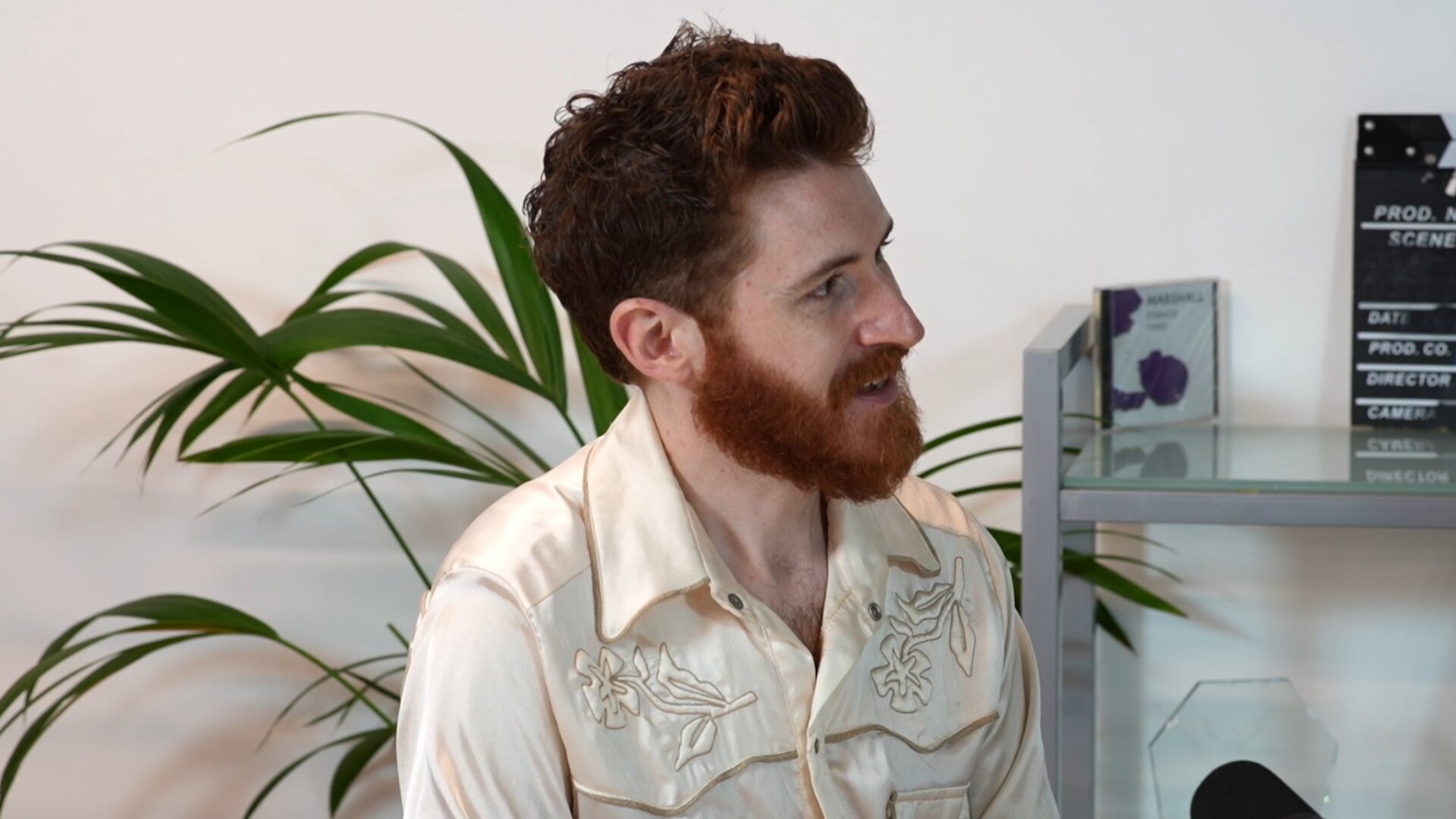
Director Bailey Tom Bailey talks about the ambitions, inspirations and influences behind the creation of the film.
Satisfaction — two groups of women meeting to duel with pistols in 1790s England over a grave insult — won Yoreflix's inaugural short film competition. It reached the screen on about £10,000, third place in a competition that invented third place halfway through, and a house Led Zeppelin once let fall down. Its director Bailey Tom Bailey talks to Yoreflix founder Imogen Cooper about why he wanted the grass to be khaki, casting against poise, and the six-part series he and his writer are building out of it. Recorded before Yoreflix launched.
Thirty-five scripts, and third place
Imogen Cooper: Tell me about Satisfaction — the period, how it came about, what filming was like.
Bailey Tom Bailey: It came out of a competition run by Centre Frame. There were a lot of five-page scripts, and I was very diligent and read all thirty-five entries, which was a great education in itself. Through that I met Chris, the initial writer, and his stood out for several reasons. Really interesting use of language. And it's a way we haven't seen duels before — or women. Women duelling.
Satisfaction is set in Georgian England, just pre-Regency. Two groups of women meet to duel with pistols over a grave insult.
IC: I've watched it about fifty thousand times. I now know all the subtle facial expressions that are coming up in the next shot.
BTB: It worked really well in five pages and heads all the way up to a punchline. Chris had a lot of context around it. There's a war on, and it's just after —
IC: What was the year? I know it's the 1790s.
BTB: There we go. Chris sometimes has to back me up on the research. One of the characters was American, or had spent time in America; another had been in a war. That's background we developed further, because we're also moving towards a long-form version.
We got third place in the competition, which was originally for ten thousand — we thought, we could do it for that. They sort of invented third place in the middle of the competition. It was new for them. So we got two and a half thousand, which was great, but not really enough to make it.
Then there was almost a year of me saying to the producer, Merrick Lichtenberg, if you want to look for the money we can do this. I didn't want to keep crowdfunding. Chris found an angel investor, and eventually I put some money in myself.
IC: What was the total in the end?
BTB: We got it back to about ten for the production, and a bit more afterwards — we went over in post. Then Iron Box Film came in and funded the festival run. That was putting my money where my mouth is again, which I've done in the past. You can't keep doing it forever.
IC: It takes a bit of guts. Fair play.
A field you can actually shoot in
BTB: The most difficult thing was the location. It's set outside, and I'm sure when Chris wrote it he thought, it's in a field, this will be easy. But try finding a field that's accessible, where you won't see the road, that isn't under a flight path. We looked at parks and public places, and I just knew we'd end up with somebody crossing frame really slowly, taking forever, while we all shouted.
Another producer, Nathan Craig, came on board and suggested Hammerwood, which doesn't much like to advertise itself. We needed private grounds, so that solved it — and then the house turned out to be a bonus.
IC: It's amazing.
BTB: The buzziest bit of history is that at some point in the twentieth century it was owned by Led Zeppelin — I think the whole band. They let it basically crumble. The man who owns it now bought it and has been doing it up, sometimes with volunteers, over the last thirty or forty years.
Why the grass had to be khaki
BTB: What I was originally looking for was a location with graphic elements — a really great tree, and there was a great tree. But what I loved was this long grass that looked a bit like a wheat field.
It's a superficial thing, maybe. Really green fields on digital, in daylight, always look horrible to me. I wanted something khaki, warmer. And it leant into something we were already thinking about, which was making it a sort of pseudo-Western.
IC: I love hearing about that level of detail — the exact colour of the grass. I couldn't be a director, I don't think I'd let my brain go into those details.
BTB: One of my philosophies has been that you have to have an idea for everything. Just make yourself think about it a little bit, and then hopefully you create something cohesive, and those ideas layer on top of each other.
IC: I'm an executive producer in every sense of thought. I'm the person going, well, what does that do to the numbers? Why is the director talking about grass, can someone stop them. But you need both.
Casting: "no princesses"
BTB: Chris is primarily an actor, and around that time he was cast in Stranger Things: The First Shadow in the West End, which I think encouraged him to put money in. He'd worked with Chloe Blake, who became our casting director. A lot of how good the cast is comes down to her. She'd worked a lot with the National Theatre, so she had a good perspective on up-and-coming people in television and from the theatre. And she was really patient with me.
There's a mix of experience. Gwyneth Keyworth is the best known — a Welsh BAFTA nominee, recently on the BBC in Death Valley with Timothy Spall. Michelle Moran has done a lot of theatre and is doing more and more television. Then a couple of newer people: Mia Khan, who'd been in Steeltown Murders, and Ellie Gallimore, who hadn't done a lot of anything and did an amazing job.
Chloe advocated for her — she said she has a natural poise that will work well for this. Which is true, but I also encouraged her to work against it a bit for the character. My thing was: no princesses. I didn't want that whole way of being to become a barrier to them being the characters.
IC: Some directors want absolute final say on casting. How did it work here?
BTB: It was pretty much me. I'd have loved someone with a bit of a reputation to raise the film's profile, but primarily it was who we thought was right. Chloe felt we wouldn't really be able to have people read for it, given the category we were going for. I'd have preferred that — I generally like to get to know people. Some of them had work to look at and some didn't.
We talked about having an open casting, and about diversifying the cast. We were interested in doing that but didn't want to force it.
IC: People underestimate how important a good casting director is — holding all of that so you can focus on the person and on directing them.
BTB: The hardest thing was just finding material for everybody. That took so much time, and it was really well spent. And I tried not to just cast people I'd seen doing costume work. I wanted real character actors.
Costume, and two names
BTB: Next was costume. I'd been speaking to Molly Langford — I don't know if she's up-and-coming any more, I feel like she's very much arriving. I hadn't had any intention of doing a costume drama at that point, but she'd done them. She'd worked with Sandy Powell and Michael O'Connor.
IC: That's the second time today I've heard both those names. For anyone who doesn't know them: Sandy Powell was the costume designer on Shakespeare in Love, which is what she's best known for.
BTB: And Scorsese, a bunch, I think. She's got pink hair. She's excellent.
The characters are very distinct in the script — distinct voices, distinct accents — and keeping that was important. I was thinking about the aesthetics of the whole film and how colour worked overall, which is why I needed my warm yellow field and then the colours of the people in it. We were probably going to have a pink lady and a blue lady; it was a question of who.
A Western, and Barry Lyndon
BTB: The film I thought about most was Once Upon a Time in the West, which is obviously quite different. I'd been doing comedy work, which I've moved towards in recent years, but I was keen to do something more of a thriller. So we leant into the thriller element — it's a kind of Western shootout.
The other thing in my mind was Barry Lyndon, and the duels in it. There's an absurdity to them, a cheapness of life. So I wanted to draw this out — complicate it, make it more of a rollercoaster. It's been really fun to sit in cinemas and watch people react.
IC: It's seven or eight minutes long and endlessly watchable — you pick up different things every time. It also has a comedic feel, and that's quite a controversial area. How comedic can historical drama be? How serious does it need to be? Do the costumes need to be exactly right? My favourite things are like Satisfaction, where you can tell from the language and the costume that it isn't contemporary, but it's playful and still feels like a contemporary story.
BTB: The more I've made, the more I've been interested in doing things I hadn't anticipated. I'd never really considered doing a period drama, partly because it's difficult on a short film budget — so I wasn't completely steeped in that world, and I could ask how to shake it up.
I like a comedic veneer over a high-stakes story. Some of the performances went a little bigger than I'd anticipated, and we let it sit there, and I think it worked.
Storyboards, and then letting the actors have it
BTB: I storyboarded everything. I've stopped doing it as much as I've got busier, but I used to not just storyboard but make an animatic of the whole thing, so I really have a plan.
What was great is that within that, the actors fleshed it out and added details I couldn't have thought of. My job became deciding whether those things should stay in — sometimes an adjustment on the day, sometimes something else. I'm grateful to them, and pleased I didn't come across as too rigid.
IC: So much of directing is building a relationship with the actors and making them comfortable enough to do their best work. I never really appreciated it until I was on film sets and saw how much of it is happening all the time.
BTB: Especially for something like this, which is a character piece in a lot of ways. What attracted me to it was that Chris had written such clear, strong characters with very different objectives.
He's got a bit self-conscious since about the stylisation of the language. It's a kind of period slang — almost a bit like A Clockwork Orange. I think it's cobbled together from real things he's read. One of the great things about being an actor is that you're forced not just to read but to internalise so many texts, and he's done that for decades, so he has all these little words and puts them together in his own way. It gave the film such colour and texture, and defined the characters so well, that I'm keen we continue it into the long-form series.
Guns for hire
IC: Tell me about the longer form.
BTB: Chris has led a lot of the development. We're aiming at a limited series of six hour-long episodes, though there's room for it to be a story-of-the-week returning thing.
It starts a little earlier than the events of the short. Belinda Allendale, the heroine — the lady in black — becomes a fallen woman, disgraced from her family because of the insult that's part of the film. She and Anne Scully, the doctor on the opposite team in the short, join up. They both have a fall from society, and they become guns for hire, travelling the length and breadth of England through high and low society, fighting for women's honour for money. So not completely altruistic.
Chris wrote a very colourful description of how we were going to rip the frock off Jane Austen.
When we were doing the short, I kept saying — and this is an unfortunate combination of words — it's like dirty period. The idea was that we wouldn't get caught up in the stateliness of historical drama. If you're doing something in that era it is about the restraint society puts on people, and the mannerisms, but that shouldn't hold back the drama or the characters or the actors. So as the story has expanded it's become about moving between that restrained society and one that's more chaotic, and much less well documented.
IC: There are lots of novels set in that period that have never been adapted, which surprises me, because it's so rich — you only have to look at Satisfaction to see how amazing that period is on screen. And existing books, existing IP, unadapted. I think everyone just thinks Regency, Georgian, Jane Austen, and that's as far as it goes.
BTB: It's how the boundaries of the genre have been defined. We're interested in breaking out of that. Chris has been finding really interesting things through research — proto-feminist stories, proto-LGBTQIA stories, and looking at the underclass and how it lived at that time.
Bailey Tom Bailey's Satisfaction is available to watch on Yoreflix. This interview was recorded before the platform launched, and has been edited for length and clarity.