
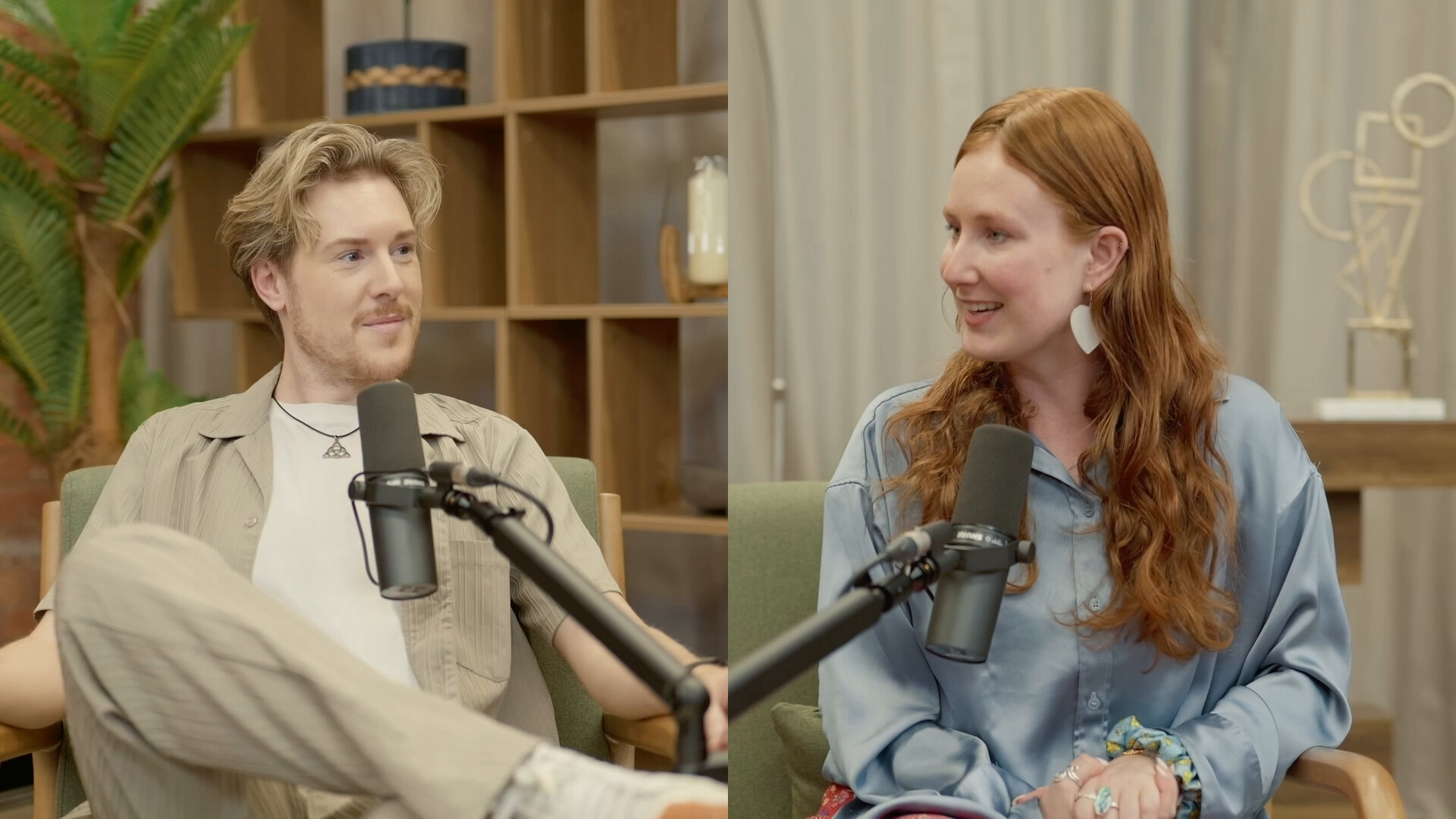
From Rococo menswear at Versailles to a Shakespeare sonnet filmed in Stratford-upon-Avon, actor and historical creator Florian Hencher on bringing history to the phone screen and writing Voltaire for Yoreflix.
Florian Hencher is an actor, writer and historical content creator. He trained at drama school and began in fantasy, then built a following by recreating the past for the phone screen, from Tudor corridors to the gardens of Versailles. One of his Rococo videos has passed 30 million views. He wrote and stars in The Fair Youth, a vertical film inspired by Shakespeare's sonnets and shot in Stratford-upon-Avon. He also wrote The Pen That Will Not Bow, Yoreflix's first original film, in which he plays the young Voltaire. Yoreflix founder Imogen Cooper talks to him about what the past smelled like, men in makeup, the history of redheads, making film for a vertical frame, why authenticity matters in an age of AI, and the real people behind both films.
Hampton Court, and what the past smelled like
Imogen Cooper: The first question I always ask is this: if you could go back to any period of time, as yourself or as a historical figure or character, where would you go, and why?
Florian Hencher: That's such a good question. The first one that comes to mind is the Tudors. I know it's a popular period with its own fan base, but I'd love to go back to Hampton Court in the 1500s. We have so many portraits, and people are fascinated by questions like what did Anne Boleyn actually look like, and what did Henry VIII actually smell like? I'd love to walk down those corridors and experience the place: not Henry VIII, but what the place smelled like. A sensory experience of the past.
IC: I wonder if anyone does sensory exhibitions of the past. If no one's doing that, they should.
FH: We should do that. Let's turn the film we're working on into a sensory experience. Imagine the wigs, the powders. It must all have created such a specific smell. Elizabeth I had egg whites in her makeup routine, didn't she? So what did she smell like?
IC: This is not how I thought this podcast was going to start.
FH: I didn't think it was going to go like this either.
IC: We could talk about historical smells for an hour. So: the Tudors.
FH: The Tudors. And then, of course, the Rococo, the eighteenth century, which is a huge fascination of mine. The costumes, the etiquette, the society, and especially how men presented themselves.
Men in makeup, and 30 million views
FH: As a man in this modern age you hear a lot about gender roles: men should look like this, women should look like that. One of the things that pops up on my Instagram when I post historical content is that people don't like men in makeup. Where have men gone?
IC: That's one of my favourite reels of yours, the one that answers "why don't men dress like men any more?". You're in this wonderful outfit outside Versailles, as if to say: well, let's go back 250 years.
FH: That video went insane. I had to turn the comments off when I needed a break, because it was such a trigger point. People were offended by seeing men with hair, makeup and lavish costumes.
IC: I know it did really well.
FH: Overall it's had 30 million views. I can't describe what it does to your inbox. There's so much wonderful feedback, but I'd be lying if I said the negative doesn't seep in.
IC: What keeps you focused when you get that kind of feedback? Do you just switch it off, or do you engage? I'd really struggle not to.
FH: I do engage, and I try to look at it as my own PR. I think about how I'm monitoring my own footprint online. There are responses I'd love to give and know I can't. What I can do is use the opportunity to educate. If there's room for a conversation, I'll say: have you actually researched what men looked like 250 years ago, in these parts of Europe, and the fashion that was popular then? If I can facilitate educating people, I will. And then there are people who don't want to be educated, who just want to be a troll, and I won't engage with them.
A history of redheads
IC: I'm going to go back to the Tudors just to wrap up that part of the conversation. I have such an affinity with the Tudors, because I think it's the only period where I'd have been heralded as a redhead and not sent immediately to the stake.
FH: It was your time period. And I was told that in a lot of the portraits the hair was painted redder, because it was the fashion. It was their form of Photoshop. So I'd be curious to know how many people really were redheads.
IC: There's probably a bit of that in the Pre-Raphaelites as well.
FH: Another stunning period. The Ophelia painting: that is you.
IC: That is me. My mum had all the Birth of Venus kind of paintings up in the house where I grew up, and she always says she manifested a redheaded child.
FH: When I was a child I was born with red hair, and I have photos to prove it. I had red hair until I was somewhere between seven and ten, and then it faded. I remember being bullied for the red hair and the freckles. A girl once said to me, "I'd fancy you if you didn't have red hair and freckles." And then, as I got older, I really wished I'd kept it. My facial hair grew through red.
IC: I'd love to watch a history of redheads, because there's been that persecution throughout time. You still get it now: there's no institutional way of telling children not to bully a redhead, so everyone does it. And then there's the sexualisation. Especially as a redheaded woman, you're bullied when you're young and sexualised when you're an adult.
FH: It is so true. I was starring in a film, one I hadn't written, and when we narrowed the casting down, the top three contenders for the lead were all redheads. It wasn't by choice; it was an accident. And I said to the director, I've never seen a redhead be the central character. They're usually the sexualised character or the sidelined one, unless you're Queen Elizabeth. In most castings the lead is blonde or brunette. So it was really nice to see a leading lady be a redhead. Actually, we can thank Outlander for that.
IC: True. They did a lot for that.
From fantasy to history
IC: Going back to the Rococo content: what led you to start making it?
FH: Since I graduated from drama school I'd been mostly doing fantasy. I'd got stuck in the fantasy niche. Not that that's a bad thing, I absolutely love fantasy, but I felt limited. And I love history. I started doing historical re-enactment with companies that do it, and being an actor on social media you realise you have an outlet to share your creativity with an audience. As my audience grew I thought: maybe I can make content with more depth to it. History gave me that. There's the fascination with getting it right, the research you have to do, and going to these incredible buildings.
There was a turning point during COVID. I almost went back to university to study history. I was filling in the applications, deciding between a six-year part-time course and a three-year full-time one, when a company approached me to do a Channel 5 docudrama. My dream was to do something like Tracy Borman, to be a historical presenter, using my acting skills to really get involved with history. And then I realised I could do it myself. If you have a camera and an audience, you can do it. Then I got to work at Ludlow Castle, and at Versailles.
IC: What was it like being at Versailles?
FH: There are no words. It's as magical as it looks. I worked with Meg, a costume designer (her Instagram page is Meg Atelier), and we came up with a concept for an original character, taking influences from fairy tales and historical figures: the Sun King and Beauty and the Beast. When you get there you have the grand stairs, the gardens, the Hall of Mirrors. It's a complete photo opportunity, but you also feel you're walking in the footsteps of those people. I want to tell those stories.
Why historical drama teaches
IC: I think there are so many rich stories in history, and I think it's twofold. The visuals you can create by tapping into historical periods are second to none. But there's also what you said about education. I'm a firm believer that we learn more from the past than from anything else, and that people who disregard history are doomed to repeat it.
That's why I like historical drama specifically. As a race, human beings don't take well to being educated. It's a skill to educate somebody and have them receive it. But people will sit down to watch a historical drama and be on their phones the whole time: did that really happen? Was this person really married to that person? Was that person really killed for that reason? People learn through it, in a way I don't think is respected as much as it should be.
FH: And that's why it matters that it's done right. I understand there's creative licence. I know costume people love historical accuracy, and I know it isn't always done correctly. What I've learned as a filmmaker is that you can't always be completely accurate, because actors need to be able to show expression, and some things have to meet Hollywood in the middle so the result is beautiful enough to reach a wider audience. But on one film I did get my way a little, because I'd done so much research on the hair and makeup. The question was how to work historical accuracy into some scenes, so that people who love history get the richness of the period, while people who aren't interested in history can still learn from it. You have to lure them in with the aesthetic.
Candlelight and stockings
IC: And how far into it do you show an intimacy scene?
FH: I love those, and that's actually what launched my historical work. I didn't even realise I was doing raunchy material. I think the Rococo period lends itself to it, because men could be sensual. Now, if I'm not showing my legs and stockings, people ask where they are. I now know a little of what women go through online, because some of my inbox was: wow, so this is how it feels.
IC: When did you first think, I'm going to get my legs out on this one and see what happens?
FH: It was 40 degrees outside, and there was a trending TikTok sound going round. It has swearing in it, so I won't repeat it here, but you can find it on my TikTok or Instagram. I just thought: how would they have coped with this heat? So in the video I sat there in the costume, stripped it down to its lower layers, threw the wig off and fanned myself. People did comment, but I'm still wearing more than most people on Instagram. That's how it started. Then I wanted to explore the more romantic side. I love working with candlelight and soft colour palettes, and the boudoir lighting suited fewer layers. I tried it with more clothing on and it didn't have the richness.
Filmmaking in a vertical frame
IC: Something I'm really interested in is what happens when you move between being a trained actor and filmmaker and creating content for social media. Content is a slightly taboo word in some circles. But it's something we're doing at Yoreflix, and something you've been actively working on with us. We're entering a new age of creation, whether you call it content or film.
FH: Vertical drama.
IC: Yes, a kind of creation that goes beyond the traditional formats. You should be able to have licensed film and television, vertical drama and short-form content all in one place, for people to watch however they want to. And those places shouldn't have to be dominated by AI slop to make them viable.
FH: Thank you for mentioning that. I'm boycotting all of that at the moment.
IC: In the conversations I have on the financing side of Yoreflix, I hear: leave the film and television industry behind, it's dead, the money is in content creators. And part of the reason that generates money is that so much of it has been infiltrated by AI content, which I think is the antithesis of what creation is. I sometimes get in trouble for saying that. Some people make social media content and some make films, but they're all creating. So why aren't we bringing those people together, instead of pushing them apart? How do you stay true to the filmmaker in you when you're making content?
FH: My training was theatre, film and television: working with cameras like these, with a crew, with scripts and all the preparation that goes into them. Content creation is much more independent. The way I work is to bring the elements of filmmaking into it. Anyone I've collaborated with will tell you how much time and detail I put into the set. The only real difference is the equipment. We're working with a mobile phone, not a cinema camera, because it's going to be portrait. So you set the shot differently. I was taught to work in three layers of depth: a foreground prop, a candle or whatever it is, then the actor, then the background. You keep that, but in portrait. I like the professionalism of filmmaking, and I've adapted it to the vertical frame.
With the acting, you do have to look at the style. Vertical drama isn't known for its acting; it's very heightened. I was listening to another podcast about how scripts are becoming more descriptive. An actor says "I'm leaving now" so that people scrolling on their phones can still follow by ear. And I thought: let's not dumb down scriptwriting. The battle I've found myself in is not wanting my work to lose that richness and the quality of the acting. That's something people have praised, and it's something we're fighting for.
The AI question
FH: Just this morning I found a history page that was entirely AI, dedicated to reliving history, and people were going crazy for it.
IC: It's a tricky one, because you almost can't fault the people doing it. They've found something that brings them success and brings them joy. But it leaves you asking where the authenticity will live, and the business goes wherever the attention goes.
FH: It's something I'm really trying to teach my audiences, and it's a fine line between educating and lecturing. The real work maybe isn't as quick to scroll. It's easy to scroll past, because the AI is so visually bright. But there's so much historical inaccuracy in it, and it takes people's likenesses, and people just don't see that as wrong. I read an article by someone who animated Disney characters. That's their intellectual property, and people are effectively taking someone's creation to make their own version, with no real way to track it or do anything about it.
The Fair Youth: Shakespeare's sonnets, in a vertical frame
IC: And obviously something we're working on together is a Shakespeare sonnet, in vertical form.
FH: With no AI in it at all. What I love about historical work is the research. Imogen and I have been working on a Shakespeare piece inspired by one of his sonnets. It reimagines Shakespeare's love life, if you like. Were the sonnets he wrote to the fair youth a same-sex love story? We can only explore that, and I explore it through my own lived experience as a man in a same-sex relationship. My partner is actually in it.
IC: I didn't even realise at first. I thought, I really recognise this guy.
FH: The opening is my own writing, which is lovely, my own work merged with William Shakespeare's. The first thirty seconds are modern-day text, so the viewer thinks I understand this language, and then it moves into Shakespeare. I was originally writing it for my own platform, before we agreed to put it on Yoreflix. Then I looked at the portrait of Shakespeare and thought: I don't look anything like him. I look like the fair youth. So I looked at my boyfriend and said, do you want to be in this? He's been incredibly supportive of all my work. There's an intimacy scene, which felt strange to bring him into, but he was very professional about it. In reality it's not intimate at all; it's coordination and choreography. I wanted to bring light to the sexuality that lingers in history.
IC: That's one of the beautiful things about historical drama: you're presented with the facts of human nature. And if you can lean into that unapologetically, there's something really freeing about it.
FH: And it's my lived experience. They were still people, with desires, impulses and attractions. There are well over a hundred sonnets dedicated to this one person. Roland, the voice-over artist on the film, told me the theory is that it was the Earl of Southampton, and based on the portraits historians say this looks like him. That's the theory we've gone with, and we can only say it's our theory, our reimagined version of that time.
Everything people will watch is something I constructed myself, not AI. We worked with the Royal Shakespeare Company on the costume. Jen, a costumier at the RSC, put that look together, and when I saw it, it was ironically the most expensive piece. I said, it has to be that one. Forget the budget, it'll be worth it. We shot the whole thing in Stratford-upon-Avon, which is so special, because the buildings are all really there. We shot in a pub Shakespeare actually went into. It was owned by a friend of his, and it was a hotel before it became a public house. It's called the White Swan. Inside there's a mural, a real fifteenth-century painting. When they were renovating in the 1920s they pulled the wood panelling away and found it completely preserved. What I love is that this is how those people drew themselves. It's almost historical confirmation that they wore these clothes, because this is how they visualised themselves.
IC: The sonnets were written over 400 years ago, and he might have meant so many things. You're taking his artistic expression and putting your own on top of it. I don't think AI can do that.
FH: And the letter scene was so important to me, because my original inspiration was Elizabethan love letters. How did men and women write to each other then, and how did they express love? I might continue that as a series. So I learned how to construct a real letter, and I wrote the whole thing with a quill. You can see the actual text I'm writing in the shot. There were a lot of splodges, but I kept them, because that's probably what would have happened at the time.
IC: It still makes me chuckle that when you sent me the intimacy scene for the first time, I was lying in bed with my boyfriend, and I'd just been sent a video of another man's buttocks.
FH: My buttocks. I had to give you a trigger warning. But I built a fifteenth-century bed for it. We'd been talking to Mary Arden's Farm, and they did give us permission to film there, but a week after we'd shot it, because we were on a deadline. I'd built all my other sets anyway. Only one set in the whole project was a real location, the writing scene, and I was in awe when we got to shoot there. There's real joy in building the rest yourself, and my training didn't teach me that. It's learning to be creative from every angle. It makes you a better actor too, because you learn what everyone else's job is, so you bring ideas in a way that supports the filmmakers when you're not on that side of the camera.
IC: I love how involved you get with your projects. You can feel that someone has put their energy into making something authentic but also beautiful. One of the first cuts you sent me had the Shakespeare in Love music over it as a temp track, and I was trying to stop myself from shedding tears.
FH: That was the reaction I wanted. What's hard now is that I've watched it so many times in the edit. My boyfriend has heard that voice-over again and again while working opposite me, and he had the same reaction. He said he wanted to cry when he saw it.
IC: It pulls on your heartstrings. And the more of that feeling human beings get from art, the better for everybody.
Voltaire, and The Pen That Will Not Bow
IC: So let's talk Voltaire. We're working together on The Pen That Will Not Bow, which is going to be Yoreflix's first original project. You've written it, and you'll be playing Voltaire. What are you most excited about?
FH: I'm trying to contain my smile for the camera. My background is mostly historical fiction: I take elements of history and apply a fictional character to them. Voltaire is the first project where I've had to get properly into the facts of a real person. When we were building the storyline I went through my research, and I asked a friend who lives in Paris to fact-check me, because this is what they learn at school. Then I had to choose the point in his life that would be most exciting for an audience, age-appropriate for me and the actors we were bringing on board, and a rounded chapter, because it's a short film.
And it gives a real spotlight to our lead actress. What a story she had. When I was researching Adrienne I thought: she's the Satine of real people. I love Moulin Rouge. She was the most famous actress in Paris.
IC: There's a real presence to that character, and I love characters like that. I love Satine, and you've also mentioned The Phantom of the Opera before. Women treated so poorly by society, who still have the strength to do what they did. That kind of strength is so powerful to portray on screen.
FH: And Voltaire and Adrienne both go through that, both establishing themselves. He's finding fame through his work and she's doing the same. It was the perfect coming-together story. When I first sent you the script it was much more focused on Voltaire, and in redrafting I realised the gap that needed bridging wasn't about him. It was about her. She has so much more depth. When I researched her, I understood much better why they found each other.
IC: Structurally it's really evocative: two parallel rags-to-riches stories, both people finding their voice inside systems that don't respect them. You expect them to converge at the top by the end. And then she dies.
FH: From my research I think he was in love with her. We've worked in a lot of the facts on record, and even lines both of them actually said are in the script. Sometimes I go back and research something and find I've already written it, without knowing that piece of information, because when you're writing a real person's story you start to relate to them. He was something of a player, and he got himself into trouble many times. It was suspected they had a love affair, and that's hinted at in our script.
What I found more interesting is that the timeline crosses with Maurice, a very handsome man of the time. And annoyingly, he was liked. It's easy when a character isn't liked, because the audience can go on the journey of wanting her to end up with Voltaire. But Maurice isn't a villain. He's present when Voltaire is shamed, and he actually helps Voltaire with Adrienne in that moment. I won't give the line away, but to paraphrase, Voltaire asks her why she keeps loving men like this, men who will only use her, and she says: what else am I meant to do? This is how I progress in society. What is a life without love?
She and Maurice had a long relationship. Voltaire goes to London for two years, so what did he expect? He comes back, and she's with Maurice, who is married, which is why there's a rumour that it was Maurice's wife who poisoned her. But what fascinates me is that Voltaire can't have felt so betrayed by her loving someone else that he wouldn't write the poem about her that became so famous, about the actress who died. There was a bond beyond attraction. She was his muse.
IC: I studied history and English literature, so I love any story that brings the two together. It's similar to what you've done with the sonnets. The poem comes at the end of the Voltaire film, and it's almost as if you've worked backwards from it, into the story of the woman who inspired it and the point in Voltaire's life when he wrote it. Taking a real piece of writing and unravelling the story behind it.
FH: It was a wonderful place to work from, and I hadn't done it before. When you write about real people you have to go by what they put into the world, and that gives you a structure. All you have to build is the conversation between the characters. I discovered something later, too. There's the scene where Voltaire says to Rohan, you will be the last of your name, and I will be the first of mine. In that world of names and status, that was the most offensive thing you could say. I'd written Adrienne into that scene because the story needed her there, and then I found out she really was there. They were in the theatre box together. There are a few differences I had to write so the story moves at our pace, but it did happen in the theatre box, and she was there.
IC: It's a beautiful script, and I'm so excited to see it come to life. We can say now that we have the amazing Georgia Hirst playing Adrienne, and I think the two of you together are going to give an incredible performance. I have to produce it for Yoreflix, but I can't wait just to be on set and at least try to enjoy the process, if I'm not running around as usual. That's the hard part of putting all the puzzle pieces together: you don't get to sit and watch a take and think, that was beautiful.
It's been so delightful to talk to you about everything we're working on, and to hear about your background and how you came into this world of historical creation. I'm thrilled to be working with you.
FH: Thank you so much.
This interview has been edited for length and clarity.