
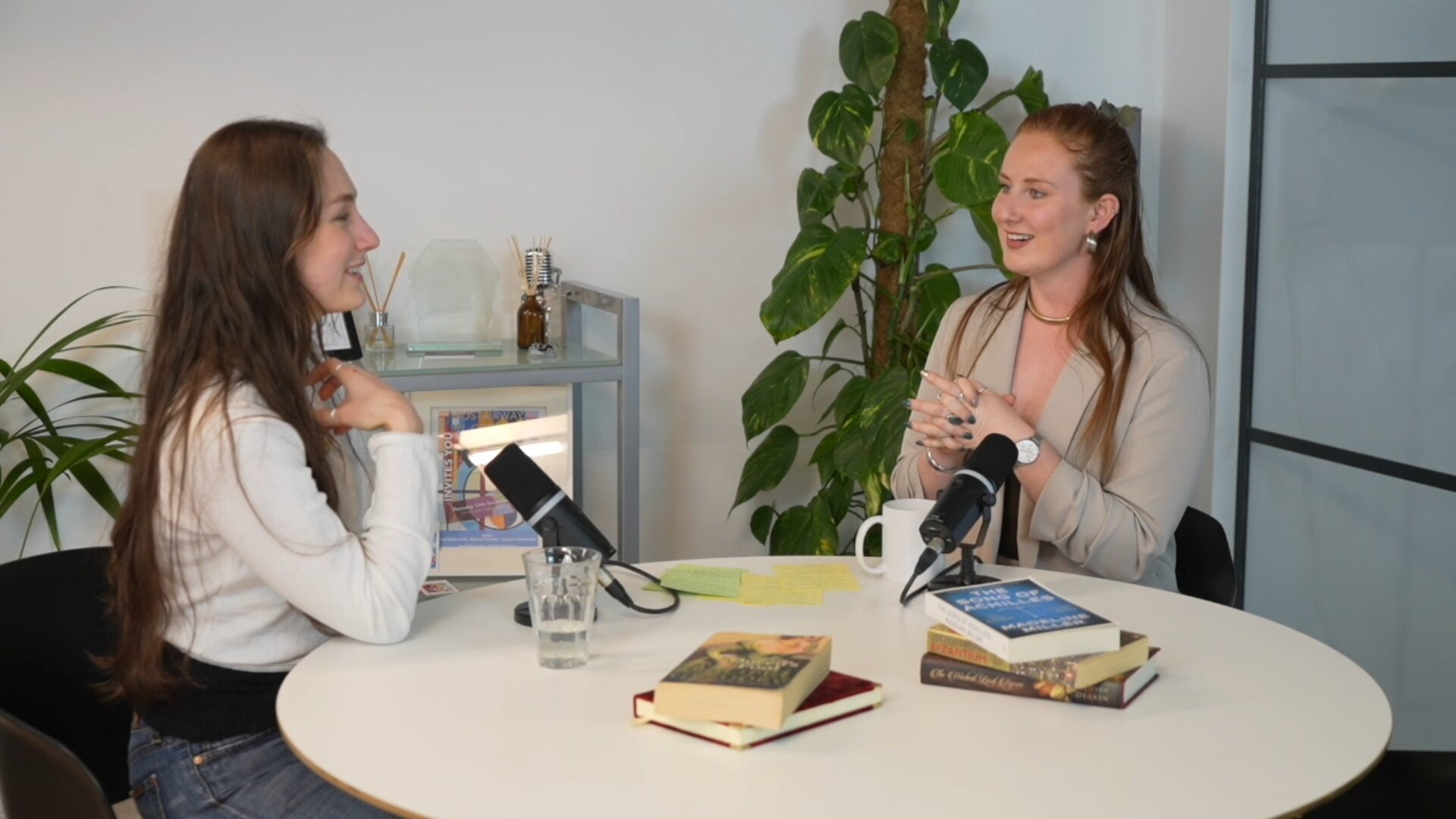
Head of social media and community, Freya Cooper discusses lots of Yoreflix related topics.
This was the first episode of Yoreflix Stories, recorded at the No Stairway studio in Chiswick before the platform launched. Imogen Cooper, Yoreflix's founder, talks to her sister Freya Cooper, who runs the company's social media and community, about where the name came from, where period drama stops and the present begins, and a list of a hundred great historical figures that found room for three women.
Building an audience before there is a platform
Imogen Cooper: We're at the fantastic No Stairway podcast studio in Chiswick, and I'm delighted that the first guest is Freya, who runs our social media and community — and who also happens to be my sister, so this can be a bit more informal.
Freya Cooper: I'm running the social media at the moment, and it's a lot to do with community building: making sure there's an audience for the platform when it launches, gathering information and data about what people are interested in.
People ask, how are you doing social media, how are you building an audience, if you don't have a platform yet? It's about getting engaged, and giving people the chance to find out about us and the shows we enjoy.
IC: You do these monthly round-ups of historical and period drama coming out on other platforms, which is something I get asked about a lot.
FC: I do get paranoid that I'm putting out the same thing, because it's so much to do with my own taste. Sometimes it's off the top of my head — what period dramas give off an autumn vibe? And I think, is everybody else getting these films and series, or am I giving away some really niche tastes to you all?
IC: The things we grew up with are a lot of the time what people react to most.
FC: There's definitely a sense of nostalgia with the genre. I've been making a series of reels that are this-or-that — old version versus new version. Little Women, 1994 against 2019. Emma. Watching it back I just thought, damn, that's so good, I want to watch this film.
"What does Yoreflix mean?"
IC: The first question I always get asked is what Yoreflix means, and where the name came from. It's a play on words — the days of yore. So if anyone ever says it back to me uncertainly, I say: days of yore. And they go, oh, yes.
FC: Some people pretend to know what it means, and you can see it in their eyes. Although I'll be honest, the first time you said it I was like, oh yes — and now, thinking about it, do I know the origin of it? No. But it feels familiar. It's a phrase.
IC: It's quite literary. And if I explain it in a room with two people, at least one of them will say, oh, well, I understood it.
Where does period drama stop?
FC: The other question I get, which is a controversial one, is what counts — which sub-genres, and which time periods.
I've been doing a series on sub-genres within period drama. So far: horror; comedy and spoof, things like Blackadder and Plebs; and recently fantasy, which I thought would be the most controversial, because the whole point of fantasy is that it's fictional and the whole point of historical drama is that it's based within truth and an actual period that existed. The fantasy is more inspired by a period — a lot of it inspired by medieval history, set in that kind of world, using the costumes.
IC: The comments on the fantasy posts were all: yes, it absolutely counts, it's my favourite.
FC: The question I get from content providers is what counts in terms of time period. I always say anything up until the 1980s, even the 1990s.
IC: Where's the cut-off — what becomes contemporary?
FC: There are two elements. There's historical drama, and there's period drama, which can be fictional stories but set in a non-contemporary time. I say up until the 1980s or 1990s — but the more contemporary you get, the more stylised it has to be, really leaning into the fact that it isn't contemporary.
Merchant Ivory, and quoting films at each other
IC: We grew up with a lot of historical and period drama around.
FC: Massively. I think Mum even applied to Merchant Ivory for a job back in the day. She was obsessed with A Room with a View and all of those films.
IC: I watched A Room with a View the other day with a friend and we screamed the whole way through. We were on the floor. And we're adults.
FC: It's left us with a lot of quotes we use day to day that nobody else understands.
IC: You get met with a blank look.
FC: There's that classic video of me aged about five or six saying, Mum, Dad, can I watch Shakespeare in Love with my breakfast? And you hear Mum in the background going, no, you can't watch that without Mummy and Daddy. We had to fast-forward the Joseph Fiennes bits.
IC: It makes a difference that we genuinely love this genre.
What the podcast is for
IC: It would be useful to say what this podcast is going to do. We'll be featuring actors, creatives, directors, writers, costume designers and production designers who have worked on historical and period drama.
FC: That's what it's for — talking all things historical and period drama with the creatives who worked on those programmes. And we're bringing in specialist academics to talk about the history behind the shows on the platform.
IC: It's a more holistic approach: not just a streaming platform, but a community.
FC: The process of uncovering, in this genre specifically, is so interesting — which is why it's worth speaking to the creatives. They're the people who delved into those stories, unpacked them, and then worked out how to portray them aesthetically.
The questions every guest gets
IC: I have a list of questions I'll be asking guests. What's your favourite historical or period drama?
FC: My go-to answer is Shakespeare in Love. Then A Room with a View, or Howards End — I think we just grew up with those Merchant Ivory films, so they feel nostalgic. And I'm a big Titanic fan.
IC: Titanic always escapes my mind when I think period drama.
FC: Maybe because it's an epic. Historical and period drama is traditionally quite niche, whereas Titanic was a big James Cameron film, so it doesn't hit the same part of your brain.
IC: If you could dramatise any period in time, what would it be?
FC: There's a real answer to this, which I'm not going to say, because I don't want anyone to steal it. There's a period ripe for dramatisation and I studied it at university — if my professor Charles West ever sees this, he'll know exactly what I mean.
I'll give you a guessing game. It's in what is now Western Europe, not the UK. Between the 800s and the 1700s. There are multiple kings, and loads of really good female characters.
Three women out of a hundred
FC: I was messaging you on the train about famous historical figures, so I Googled it to jog my memory. There was an article listing a hundred names. I scrolled through. Three of them were women.
IC: I was bracing myself for a small number, but I was expecting at least double digits. Who were they?
FC: Joan of Arc, Queen Victoria and Queen Elizabeth. Not even Boudicca.
IC: Three out of a hundred. You've got at least six of Henry's wives you could throw on that list.
FC: Who would be at your dinner party?
IC: My classic answer has always been Anne Boleyn. So much of the curiosity about meeting historical figures is wanting the feeling of them — when you're left with just facts it's hard to know where their own mental space was. How much was intentional, how much was simply out of their control. I'd love to know whether she had all those affairs. And honestly, in the 1500s, with a husband who has twelve mistresses — I get it.
FC: Mine would probably all be women. Boudicca, because she must have been wild.
IC: I'd go out with Boudicca, Cleopatra and Amelia Earhart. She flew the Atlantic in what was basically a prop plane.
FC: We've gone for the chaotic ones. Actually I'm not sure I'd want them at my dinner party — I'd want a very safe space, with someone like Maya Angelou, or Sandi Toksvig. Someone who creates a centre. Everything is coziness.
IC: Boudicca would be looking round thinking, this is a lot right now.
Characters
IC: What about period drama characters?
FC: Polly from Peaky Blinders. If there were ever a prequel, playing young Polly would be my dream — though it would be enormous pressure, because Helen McCrory is unspeakably amazing. It's what she created that makes you want to.
As an actor, some characters are just juicy. Because of how much women went through in history, there's something really satisfying to play when someone justifiably wreaks havoc as revenge.
IC: You've come at it as a performer. For me it's just: who would I want to be. Maybe a Jane Austen character. Marianne, from Sense and Sensibility.
FC: Jane Austen is somebody I'd have at my dinner party, actually. You can tell she was incredibly witty — a type of humour that's very in-the-know.
IC: Like: I've got a secret.
This was the inaugural episode of Yoreflix Stories, recorded before the platform launched. The interview has been edited for length and clarity.