
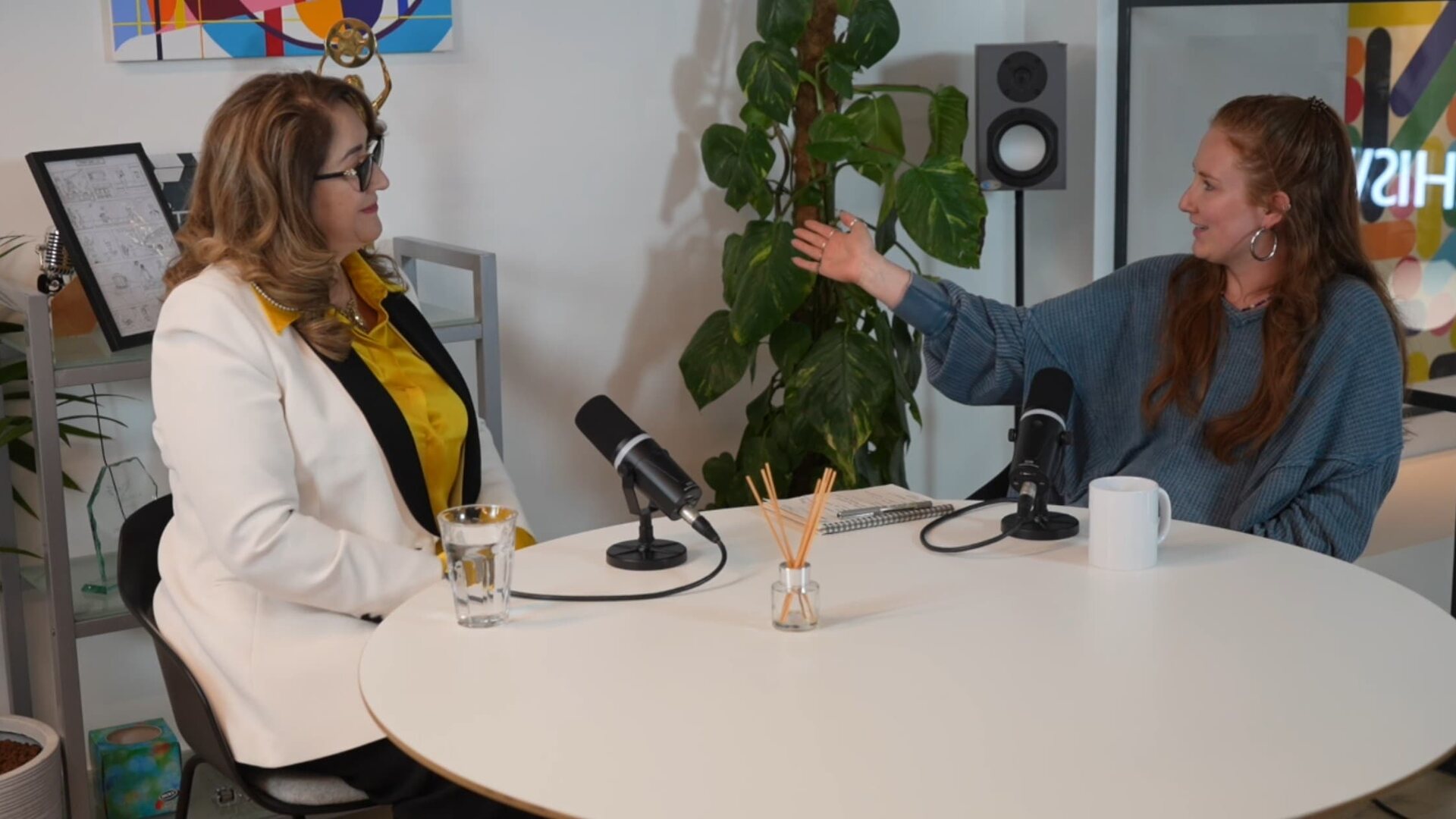
Director and international film festival founder Luba Balagova discusses film, culture and lots more.
Luba Balagova is a poet and a bestselling author, and she runs an independent international film festival that turns ten this November. She produced Cherkess, a 19th-century drama shot in the deserts of Jordan about Circassian exiles from the North Caucasus — a story, she says, that nobody had told. She talks to Yoreflix founder Imogen Cooper about programming films by people who cannot afford the entry fee, why a festival should be built by a poet, and the husband whose voice still tells her to go ahead.
"I would go back to producing Cherkess"
Imogen Cooper: If you could go back to any period, what would it be?
Luba Balagova: I would go back to producing Cherkess, without any hesitation, because that was my biggest university. My academy, if you want.
It was the happiest time. First of all I worked with my husband, my partner, Mohit Kandur. We had an amazing international crew. And we worked in a very unusual location — in the deserts, in Jordan.
IC: What period is Cherkess set in?
LB: The nineteenth century. This part of history is not well known, because the film is about a small group of immigrants — Circassians, from the North Caucasus — who had to emigrate to the Balkans. And then in the second part of the nineteenth century, when another war began in the Balkans, they had to move again, to Transjordan.
These people have an amazing destiny, and a story behind them. And it was untold. My husband was the first to tell their story through cinema. And sometimes when you think about period drama, this is what it is all about.
IC: I could not agree more. We learn from the stories of people — not just from our own culture or the place we grew up, but from the whole world. These untold stories don't otherwise get portrayed, and don't get seen by people who would benefit from having their perspective widened.
LB: Many people asked him: why do you have to make this film? Because it was never going to be a blockbuster, one of those Hollywood movies. And his answer was always the same. This is the story of my people, which is untold, and it doesn't matter. I want it to be heard.
That is why I screened the film at my festival last year. It is ten years old, and people were so pleased, and they loved it. What I noticed is that the older the film gets, the more people are interested — especially in today's political situation, people want to know more of those stories.
IC: It gives context to modern political situations.
LB: It does. It was made in the Middle East. It is about immigrants. What has changed since? What is happening now, with all humans?
A festival built by a poet
IC: Tell me about the festival. It's turning ten.
LB: I can't believe it. I remember building it as though it were yesterday, and what circumstances we had to overcome. Through these years you build your reputation — people trust you, the investors, the cinemagoers.
It was built with one idea: to bring people together from very different parts of the world to tell their untold stories. Of course we have mainstream festivals, with all the amazing dramas, all the Hollywood. I was never interested in that. If I screened films by big mainstream filmmakers, it was only so the independent filmmakers who attend with their own films could learn, and connect with them — and so those big names could see the independent films. We bring very big names onto our jury. And it worked. Some of our independent filmmakers sold their films to Amazon and Netflix, with the support of the big sharks of the industry, who did not say what are we doing here? They attended, and they were very interested.
So the festival is about bringing the new untold story from those who are less noticed — from those communities, those nationalities, those countries. That is our brand.
And as you mentioned, I was a poet. I am still a poet. So my festival is built by a lady, and built by a poet, who wants to bring the human thought, the universal human problems. Which should remind us that we all come from Adam and Eve. It should bring connection, and peace, and understanding, and cultural exchange.
IC: Something is really special about anyone who brings human stories together in a forum like a festival. It's been lost a little in the industry generally. Part of what I'm building with Yoreflix is a platform for stories that aren't being told, and that don't appeal to the streaming giants in the way they would have twenty or thirty years ago, when storytelling was at the centre of it. Now it's very much about budgets and margins, and things that corrupt humanity.
LB: That is such a precise word. And this corruption is also inside each of us, in our minds, because we worry: you will not have enough audience, you will not sell enough tickets —
IC: You won't make the numbers.
LB: That is why you have to have a poet to build a film festival. Quite often my programme director says to me: we have these mainstream films, and the films that are in competition, and we don't have enough time or budget — what shall we do?
And my answer is always the same. We remove the big films, in favour of the independent films from unknown filmmakers.
But do you know what? This is our tenth year, and we have never had an empty cinema. It is full, because the filmmakers bring their friends, they spread the word, and then they return. That is how we build our network. We started from maybe a hundred, and we have grown to thousands. It is a beautiful thing to see your festival grow, and to know you are actually saying something that is not said, and not noticed by others.
"How can you ask her to pay for her entry?"
LB: I want to know what happens to the girls in Afghanistan. I want to know what happens to the girls in Iran.
We have a name now, which is great, so the word is spread — and that is how your reputation is built too. They come to me. They email me directly, at my personal address, which I do not hide. And they say: we cannot pay for this, we don't have a budget, we don't even have a way to pay by card, because of the sanctions.
But I want to see it. And people like me want to show it — we have BAFTA members. So of course they all have free corridors. And at the end, our account is very poor.
IC: Your account is very rich. That's what I'm thinking.
LB: Last year we had a film by an Iranian girl who was very brave. She went to this place and made a film about women whose husbands leave them after they have children. The little boys and girls know they have a father, they have seen him, but he has left for a younger woman. No control, no morality. And the girl filming it was at risk. She was hiding.
How can you ask her to pay for her entry?
She won our best documentary, and we put an interview with her on our website. That is what our festival is about.
You will not see this on the news, or in some programme, because the news is about what is happening today, in more important things — they have a schedule. With my journalist background, I know that. But at a festival you will watch a little film which will tell you everything about that part of the world.
It will explain everything about yourself, about your world. It will change your conscience. You will compare yourself with that girl, and you will re-evaluate your values.
IC: I grew up entirely in the United Kingdom, and it has always bothered me that we don't get exposure to these stories in the mainstream news. If I turn on the news I don't want to see another man talking about something that is highbrow and meaningless — and then a story like the one you have just told actually means something for the human experience. It makes people question who they want to be, what energy they want to put into the world, and who they want to support.
LB: And what is the world we live in? This is part of our world. Nobody will run off this earth. We are all part of each other.
I know that games and computers are all very popular. Maybe I am very wrong, but I would rather screen these sorts of films. I want to tell people stories. And, if I can say so — humanising.
IC: Absolutely. Humanising.
LB: That is what gives me the strength to say that an independent international film festival brings a lot to British international culture. I see us as a very important part of this world, of our Western world.
IC: Historical drama works in a similar way, and for a similar reason. If people are presented with an important story, or a story from the past, through entertainment, it is less abrasive. They get less offended by what they are being shown, because it is drama, because it is a film, because nobody is telling them this is what you must learn. But it still has an impact. They are still absorbing those stories, in a dramatised form — less confrontational, but cleverer, because it reaches people subconsciously.
Irida
IC: I want to draw attention to the statue behind you, which is beautifully placed and matches your blouse.
LB: Thank you. I was looking into my wardrobe this morning for something that would match Irida. You have a good eye.
As I said — humanising, and building bridges between different cultures, and bringing that culture to the United Kingdom. Irida is a Greek goddess, known for her Olympic speed in bringing the good news, the good message to human beings, about peace. She comes from the ocean. And she is known as the mother of the rainbow.
When we were building the festival, I did not talk much about the rainbow, but I spoke about colours — about bright colours, because at the moment we have more of the grey colours. The colours of fear, of uncertainty. And Irida looks like a sun.
IC: A shining beacon.
LB: A beacon, showing the path, showing the bright light — that we have to trust each other, that we have to go into each other's lives and bring more of those messages. I live near Windsor, we live in London, and that girl may be in Calcutta somewhere, or in Africa, or in Iran. But here we take those stories into our hearts, and we are trying to change the world by telling them. By waking more people up, consciously. By letting our children learn about the world — that it is not about what you see on the surface. To make them more human, to feel more, and to achieve peace in every corner of the world.
I very much believe in the democratic foundation of Britain. I truly believe in it. That is why it is so important to me to maintain this festival in the United Kingdom, and to grow it here. This is my job — to make the world a better place. And Irida helps me.
We have fifteen categories, which are quite classic. On top of that, an Irida goes to somebody with an extraordinary destiny in filmmaking, or for peace. And a President's Award goes to the filmmaker whose film showed the main concept of the festival.
IC: I love it as an emblem. And it's also a lady.
LB: And I think they are the ones to bring peace.
Mohit
IC: You mentioned your husband in the past tense. Tell me about the story of the festival personally, because I know it hasn't been without adversity.
LB: Very much so.
We survived COVID. We weathered it. And we survived political —
IC: Turbulence.
LB: Turbulence. And still there is turbulence. But who I want to praise here, and to thank, is my husband, Mohit Kandur — who was not only my partner.
He was a Hollywood filmmaker with a great deal of international experience. He made films for the French, and for BBC World. He had a whole documentary series. He was a composer as well. He was really a genius. Imagine — he worked in the teams on Bonanza and Mannix, in old Hollywood. So you can imagine what experience he brought. And that is the quality of the festival.
IC: That's the heart.
LB: The heart. Maybe the brain. He used to say: I am the soul and the heart. And he was the brain, because I could never calculate. But the quality — and also surviving, when I had doubts, when I had fear.
I'm just a girl. I was just a girl. I am a founder, and a president, and a director of a film festival. And that is a girl.
He believed in me when the world was uncertain, when I was really stuck. And today I feel him very much. Today, when I ask myself what our next step is, I hear Mohit's voice. He says: go ahead.
This interview has been edited for length and clarity.