
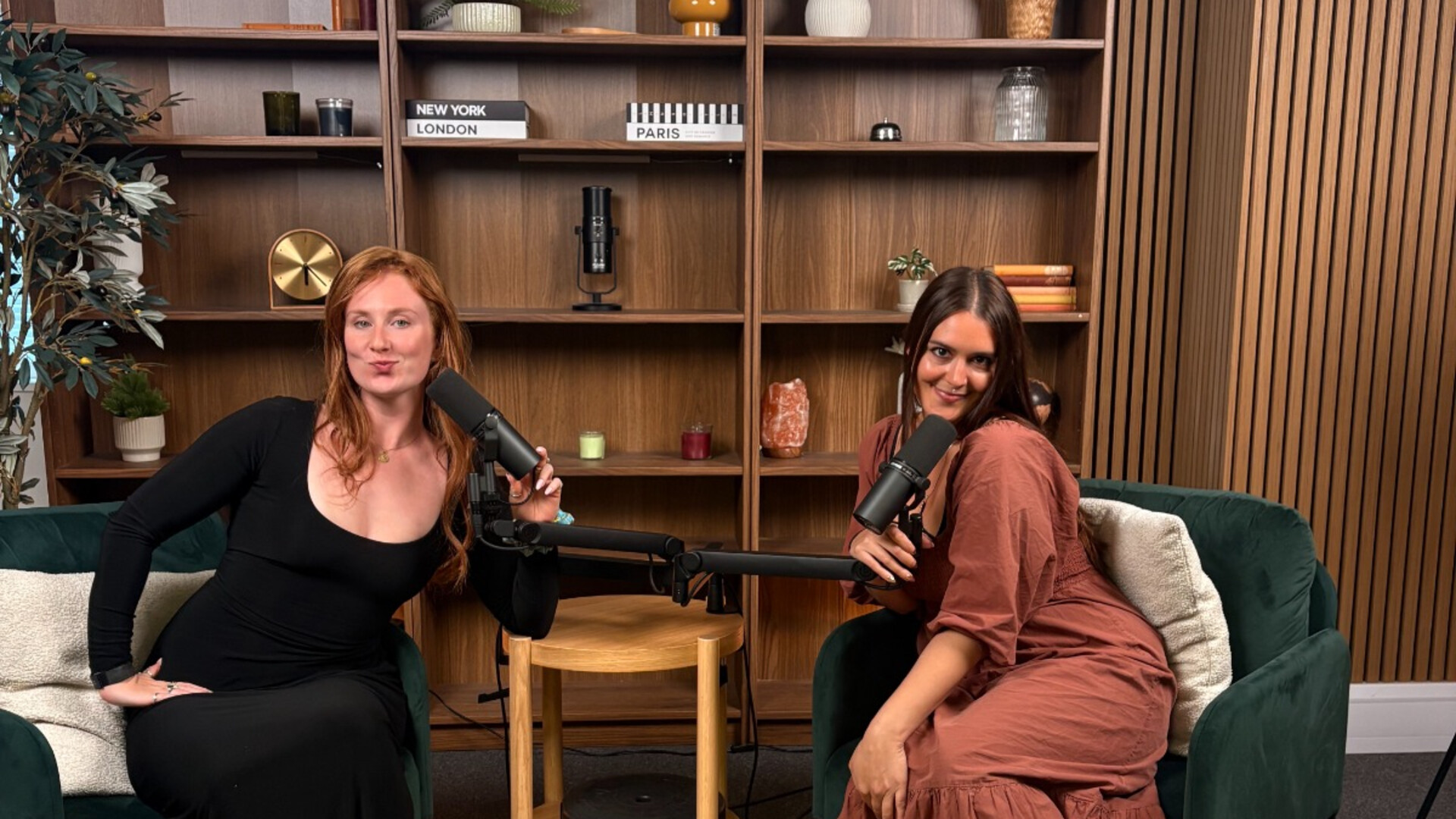
Historian and author Mina Moriarty discusses women's history, the value of historical drama, and the stories that never get made.
Mina Moriarty is a historian, author and content creator whose latest book, What Ails Her? The Forgotten and Factually Absurd History of Women's Health, is due to be published in September 2027 after five years of research; she is also the author of Who the Hell is Olympe de Gouges?, a biography of the French revolutionary playwright. Yoreflix founder Imogen Cooper, who studied the history of medicine, had a cervical biopsy with no pain relief three weeks before this conversation was recorded. They talk about one day at Versailles, why historical drama is assumed to be expensive, what a male-dominated industry does to a woman's own voice, and the stories that quietly never get made.
One day at Versailles
Imogen Cooper: The first question I always ask is this: if you could go back to any historical period, as yourself or as a character, where would you go, and why?
Mina Moriarty: I had to think about this one. If I time travelled as myself, back to the eighteenth century, I probably wouldn't have a good time. That's the difference between the periods you'd be fascinated by and the periods you could actually get involved in.
But as someone else for a day — I'm very interested in the French Revolution, the Enlightenment, that late eighteenth-century world. So Marie Antoinette, living at Versailles. People think of the glamour of it, and I think her life was quite challenging.
IC: It notoriously didn't end very well, either.
MM: It notoriously didn't end very well, and she's been quite a scapegoat for a lot of things. I'd like to see what her life was actually like for maybe one day. How she was treated, what her day to day was, and her own perception of what was happening culturally and politically.
I would not want to go back to that time as myself. A mixed race woman who isn't an aristocrat is going to have a bad time.
IC: There's quite a limited number of periods I could personally go back to, because I'd mostly be burnt at the stake for being a witch. It's pretty much only the Elizabethan era that's safe-ish.
MM: Where would you go?
IC: Probably one of the least safe ones — the fall of the Roman Empire, the tribal, barbarian times, the remaking of East and West, and how that fed into the way modern society formed. I'd be so intrigued by what those people were like, because we only know what their politics were.
MM: And who gets to record history. We know about a lot of those male figures. But what about day-to-day life?
IC: I'd go back to the periods where that's most obscured. Even with Marie Antoinette, I wonder how much of her life has been placed inside what we know about the period, rather than what her life was actually like. People take the period, glamorise it, and then put a character into that setting, rather than it being about her.
What Marie Antoinette did to the budget
IC: You like the Sofia Coppola version.
MM: I really love it. I think it's the twentieth anniversary at the moment — they're doing something at Versailles, an exhibition with Cartier, I think. It's a comfort film I've rewatched over and over.
When it was first released the reception was mixed. I think some people even walked out of the cinema, because of the way Coppola decided to depict her in a more sympathetic light. And there are little deliberate anachronisms, where she's wearing Converse in a flash. I like period dramas to be accurate, but there's scope to have some fun and some creative licence, and to be a little bit subversive.
IC: When people think about historical drama, in some part they think about that film, whether they realise it or not, because it's been so copied. Anything set within two centuries of it now has the same hair and the same costumes, even if it isn't really that period.
I love it for what it is, and for the zaniness it's got. But I don't think it's done wonders for the industry, because people think of it and think huge budget, and then decide not to make anything.
Part of the reason Yoreflix came into being is that my career is in the film industry, and so many people were saying it's really hard to get historical dramas commissioned. People are scared of them, and scared of the budgets, because you have to have the costumes and the wigs. That isn't the same for every period. But that particular adaptation is so known for its visual opulence that it's the thing that stayed with people — and then nobody can deviate from it in their mind.
MM: It's funny, because horror films and action films have huge effects budgets. Whereas you can have a historical film that's set in one house.
Portrait of a Lady on Fire, and the foreign-language problem
MM: Portrait of a Lady on Fire is another favourite of mine, and in terms of where it's set it's fairly minimal for most of the film.
IC: It gets a bad reputation for reasons that are pretty much non-starters if you dig into them. Nobody can argue the budget seemed massive, so they say instead that it's foreign language, and that's less commercially viable. And why? Is it because it's mostly female-made and skews towards a female audience, and then valued less for whatever reason?
You get beautiful pieces of art, and then they're deemed too artistic, or too female-skewing. Historical drama in general is viewed as women at home watching something indulgent. It isn't proper film. And then you look at all the male-centric superhero films, done over and over, or another action film with Brad Pitt. You could argue that isn't real either. What makes something real?
I have a big thing about films that deserve to be made and films that don't. There are a lot of historical stories that deserve to be told and are never going to see the light of day. What was it about that film that drew you to it?
MM: I love any lesbian historical drama — it's consistently a good sub-genre. I loved Ammonite as well. And I've always been interested in lesser-told stories, and history that's been forgotten or buried a little.
I like how minimal it is in the cast, and even in the music. There are only two instances of music, the Vivaldi and then the women singing. But the director talked about how important it was to still have rhythm in the scenes, so she'd have the actors move in a particular way to a particular rhythm.
It's so good because of the characterisation, and the chemistry of the actors. And because it reflects a story of queer sapphic love that will have existed in multiple iterations in the past and just hasn't been told enough. It feels like you're really in the eighteenth century, maybe because of the minimalism. It's the exact opposite of Marie Antoinette, which is very maximalist. Weirdly, those are my two favourite films — one stripped back, one over the top. And people have their qualms about both, so you really can't win.
IC: I like the simplicity too, but I also have a real thing for historical films and series in other languages — it's something we have quite a bit of on Yoreflix. My big thing is authenticity. I loved that it wasn't just made in English. English isn't very rhythmic anyway; it's much more Germanic. And you can tell it's been crafted, you can tell it isn't trying to tick any boxes. It's good to hear stories in the way they would have been told at the time.
MM: I never watch anything dubbed over. I much prefer subtitling, because it honours the integrity of the original thing. And in Britain especially we don't embrace other cultures and languages as much as they do in other parts of the world.
IC: It's also a great way to learn a language — watch a film you love over and over in your own language, then over and over in another, and you start piecing it together. I lived in Italy briefly when I was younger, on an Erasmus year, and I used to watch Sex and the City dubbed into Italian. A lot of the jokes didn't land the same way, but it helped me learn more Italian.
History gets limited quite quickly to just a study of the past. Whereas a lot of people who like history also like culture, and languages, and art, and costume — all the things that feed into how the past was made up, and what it is now.
What Ails Her
IC: You've also written a book, and you've just finished it.
MM: It'll be available for pre-order early in 2027, but it won't be out until September. It's called What Ails Her? The Forgotten and Factually Absurd History of Women's Health.
IC: What prompted this particular book?
MM: I've always been interested in the history of medicine. How did women deal with periods in the past? How did we view our sexuality? What about the history of hygiene? We were talking about an interest in everyday lives — I'm really interested in that.
And it comes from a personal trajectory as well. I have a couple of different health conditions, and like many women who go to the doctor, I'd go and say there's something wrong with me, and they'd say, you're crazy. That happens to most of us most of the time. I started to notice all these patterns throughout history in how women's health was treated, and drawing parallels with today. So the inception of it was maybe five years of being interested and researching, and then I thought, I'll write a book on it.
The cervix has no nerve endings
IC: I studied the history of medicine, a solid nearly fifteen years ago now, and it's still in parts of my brain. I studied it more generally, so I didn't touch on this massively — but something I've become more aware of as I've got older is the almost hilarious dichotomy. Women are seen generally in society as more fragile. And at the same time, when it comes to anything medical, we're the ones who give birth, so surely we can handle it.
I've had quite a few medical things happen in the last few months with no pain relief. And you think: well, I think you'll find I'm actually a bit fragile for that. I thought that's what we'd agreed.
MM: It's absolutely insane, because men get offered pain relief more often than women. Men are referred to specialists much more quickly, and diagnosed faster. Our pain is sidelined and dismissed, or treated as something we must be able to handle — which is ironic, considering everything else we apparently can't handle.
We're half the population. Most of us have periods, give birth, these crazy things that I think if a lot of men did them they wouldn't be able to cope with. But this idea of stoicism, that women should just suck it up and deal with it, is really something you see in the historical sources. A lot of it comes from the curse of Eve, the biblical idea of us paying for her sins. It's archaic, and it's somehow managed to still be a thing now.
IC: This is why I find history so important as a discipline. There's so much we could learn from the past if people would engage with it a little bit more. You think about human nature, and all the things that still continue from centuries ago — old stories that came in big part from religious texts, but also social and political ones, and still carry through to this day, and probably shouldn't. Did we actually learn from what happened previously? Or do we just regurgitate the same thing in a slightly different modern format?
MM: And it's asking why we're still doing that, and who it serves. Because it isn't serving women, clearly.
If you're getting a cervical biopsy, or even getting an IUD in, it isn't routine. I think they've actually changed it slightly recently, where they're going to offer more pain relief, but it hasn't historically been routine to offer any.
IC: I literally had that two or three weeks ago, and I've told everybody I know. You go into hospital, they say, we're going to take a biopsy. You say, oh, excellent — right now? Okay. And then they do it, and you think, oh, that really is quite painful. It's an internal organ.
MM: And when you look at these historical texts, which were obviously all written by men, they say the cervix has no nerve endings.
IC: Oh, does it not? I can confirm that it does.
MM: What's interesting about reading those sources is that the whole time, they could have just asked a woman.
IC: They weren't going to do that.
MM: In the early 1800s they were putting leeches on women's cervixes to deal with gynaecological problems, obviously without any pain relief. It isn't a leech on the cervix now, but you are getting a chunk of your cervix taken out with no pain relief. I think that's barbaric. I think it isn't treating women as humans.
IC: When I came out of the hospital I actually felt a bit like, what just happened? That does not feel like it should have happened. So I'm very glad you're writing this book.
Four women in a very long list
MM: I think a lot of these problems would have been solved if women had been able to practise medicine and pioneer more things in systems, rather than individuals just fighting to keep their heads above water.
IC: I sent you a bit of a mini list of the few women who had an impact on the history of medicine that I did learn about when I was studying it. There were about four names in a long list of Louis Pasteurs and Harveys — the men, basically. There were a few women who, fair play, really did move things forward, and then hilariously got sidelined pretty quickly.
I was telling you about the one who got her children inoculated against smallpox. She'd seen an instance of it in Turkey. Her name's not Montagu, is it?
MM: Lady Mary Wortley Montagu. Early eighteenth century.
IC: She got her children inoculated and it worked. And then doctors, who were all male at the time, took the start of that technology and started charging people a thousand pounds for it. So they got really rich and nobody could access it — which is how a lot of that history tended to go.
But this is one of the reasons I like historical drama, and there's a link here. It would be so prudent for the film and television industry to start telling some of those stories in a way people can engage with more publicly. That's where historical drama should come into play: the ways in which we make history engaging, so people are almost forced to learn about how the past went down, so we can hopefully learn for the future. Although that's questionable.
MM: People maybe don't respond to texts. If you're a historian, we're going to devour a primary source, because that's what we love. We'll go down into the depths of those libraries and have a great time. But a lot of people don't get the same joy out of that kind of research, and would still do well from knowing what's in it.
IC: So historical drama could do much more to showcase those stories. Especially because it has an audience — a really wide and dedicated audience. More people will engage with a historical drama, and learn about the story afterwards, than if you tell them to go and read the source.
Who reads whose books
MM: The part I find a bit depressing, when it comes to bringing women's stories to the forefront of history, is that women will watch men in films and relate to the character, or see themselves somewhere. But men will watch female stories and there's some sort of block. And with non-fiction, women read non-fiction by men and women, and men read non-fiction by men.
IC: Why are men being so insular, and cutting themselves off from the experience of half the population?
MM: If a film came out about Lady Montagu, you'd probably have to include the male doctor who took the inoculation for it to seem appealing to a wide enough audience. If it were just about her it probably wouldn't get the same. And yet I'm expected to turn up every time there's a film where another random white guy is fighting someone. It's just a guy going pew, pew, pew, and the woman is in it for him to have sex with, or to die.
IC: To be the dead wife, and then that spurs him on.
MM: I'm not interested in watching that any more. I point blank refuse.
IC: I made the same comment the other day — people have got a bit scared of having women in films for men to have sex with, so now they die. It's more woke to just kill her. We know it's politically incorrect for her to be a sexual object, so maybe we kill her off instead.
MM: What do you think the solution is?
IC: It's got to come from female filmmakers, ultimately. There's still such a male-oriented senior layer to the film industry. The Me Too movement started off in this industry, and that's helped. But my God, it's still a problem.
The junior lady on our team
IC: This is a problem I've seen firsthand, because I became an executive producer when I was twenty-three. Which is great, and it's fun until you're in a room with older men in the film industry, and you're patronised.
I had one meeting where I was explaining what I wanted to do with Yoreflix — what historical drama meant to me, what we were trying to do, the business models. A very normal conversation between two similarly intellectual, experienced people. And at the end of it the man I was meeting just said: well, I think I'll just put you in touch with the junior lady on our team. Those were his exact words.
MM: So dismissive.
IC: And this is the problem. You have to harden yourself so much to be a female filmmaker or producer or founder. To the point where I think I've almost forgotten how to tell women's stories, because I actually feel more masculine. I'd find it hard to really drive women's stories forward, because part of you gets so conditioned to be a bit scared of what that means in an industry that's so male heavy.
MM: You could make a film that explores that, because a lot of women can relate to it. When you're young and working in environments that are very male-oriented, you do tend to need a thicker skin, or to work out how to advocate for yourself better. Before I go into big meetings now I go: I'm a white man, I'm a white man. And then I go in. And it helps.
Also, I shouldn't have to do that.
IC: No, you shouldn't have to.
MM: The other issue is when you start internalising that feeling. I had a group of friends from school, all girls, very staunch feminists, excellent girls. And we half fell out, and one of the reasons was that I'd got more into having to advocate for myself and figure out how to stand up for myself in situations. And I just kept getting called aggressive. So there were girls who wouldn't accept it — why are you being aggressive? And you think: oh, I actually can't win now. It does start warping your psyche a bit. You grow up with a lot of internalised misogyny.
IC: If you'd exhibited the same behaviour and you were a guy, you'd be seen as strong-willed and authoritative. And it's interesting that the rejection then comes from female peers, because that does happen.
I think in general the female experience is quite tricky, and maybe that's why it isn't told in film and television as often. It's a bit of a minefield, because we've not been given the space to figure ourselves out, so it's harder to depict.
MM: There's also a bit of grief around all the stories that could have been told.
IC: It's so sad. How much more they would have expanded people's minds and horizons.
The stories that never get licensed
MM: Part of the trouble is that historical drama is deemed to need to be this escapist world. That's probably why more people look fondly on something like Marie Antoinette, and Portrait of a Lady on Fire doesn't evoke the same warm feeling. People think it should be more escapist, that you're escaping to a different period, rather than being told stories that are important to tell and feel less escapist, and are a bit harder to deal with.
IC: Because then you actually have to face the humanness. The real stories behind things, when they're less glamorous and less frivolous.
We have some series on Yoreflix that deal with quite hard themes — and these aren't gender themes, they're more race themes, to do with the Australian gold rush and the Chinese miners. Some really problematic parts of Australian history, which was in big part British history, because it was all during the colonisation times. An absolute minefield.
MM: A lot of people get so scared about talking about it, or even going anywhere near it, because they're worried they're going to associate themselves with it.
IC: And what actually happens is that they don't get shown. They exist, they never get licensed, the big players are really scared of them. Something I was really keen to do with Yoreflix is give a home to those kinds of historical dramas — the ones people are a bit scared of, but which actually form the basis of what history is.
MM: And by sidelining them you do such a disservice to the people who experienced all of those atrocious colonial acts, and then to the descendants of those people, who are now living under the echoes of those same systems. We can't just pull the wool over our eyes.
Shakespeare in Love, aged five
IC: The one thing we haven't got around to is Shakespeare in Love. I watched that film loads when I was a young teenager, and it was really nice to watch it again yesterday. It really holds up.
MM: It's my favourite, and I probably shouldn't have watched it as young as I did.
IC: When did you first watch it?
MM: Probably when I was about five. There's a hilarious video of me asking my mum: mum, can I watch Shakespeare in Love with my breakfast? And I'm tiny, mostly just hair. And my mum says, no, you can't watch that without mummy and daddy — because they had to fast-forward all the sex scenes. But I think that's where my deep-rooted love of historical drama came from.
IC: The costumes in that are really brilliant, and the cast is phenomenal. What do you love most about it?
MM: I love the characters. It's the story. Storytelling is a dying art, unfortunately. It's something that needs to be protected and preserved, and it is dying a little bit. Filmmakers are trying to bring it back with other genres; it should be brought back more with historical drama.
And the acting. Judi Dench — the way she plays Elizabeth the First is incredible. Probably one of the best depictions.
IC: It's the way she embodies it. When she's wearing that Elizabethan clothing she seems to say, yes, this is where I belong, this is where I need to be. Geoffrey Rush is also incredible.
MM: There are so many actors where things got problematic later in their careers, and that film seemed to be one that stayed relatively unproblematic as time went on — although no, it was a Miramax film, so that's such a lie. It's such a shame. There are so many beautiful pieces of film that are tainted now.
Something I find interesting about it is him kissing her while she's dressed as a boy.
IC: I love that, and this is what's good about historical drama, because it tells you things in a way that isn't this is what you must learn from this piece of filmmaking. It very subtly lets people know that yes, in this period all the actors would have been men dressed up as women, and cross-dressing was very much a thing.
MM: Nothing new about that. And there would have been liaisons happening between the men who were all acting together. Obviously it's Gwyneth Paltrow, so she isn't actually a man, but he didn't know that.
Another dimension is the way they look at gender through her character. There's a scene where they go to the pub together to have a drink, and someone says, why have you not dipped your wick yet? And she says, what? It's a male-only space that she's entering, and she's doing it with her lover.
IC: It's very clever. And that's a nice place to leave this. Thank you so much for joining me — I've thoroughly enjoyed it, and I'm very excited about everything that's going to be happening for you over the next year or so.
This interview has been edited for length and clarity.