
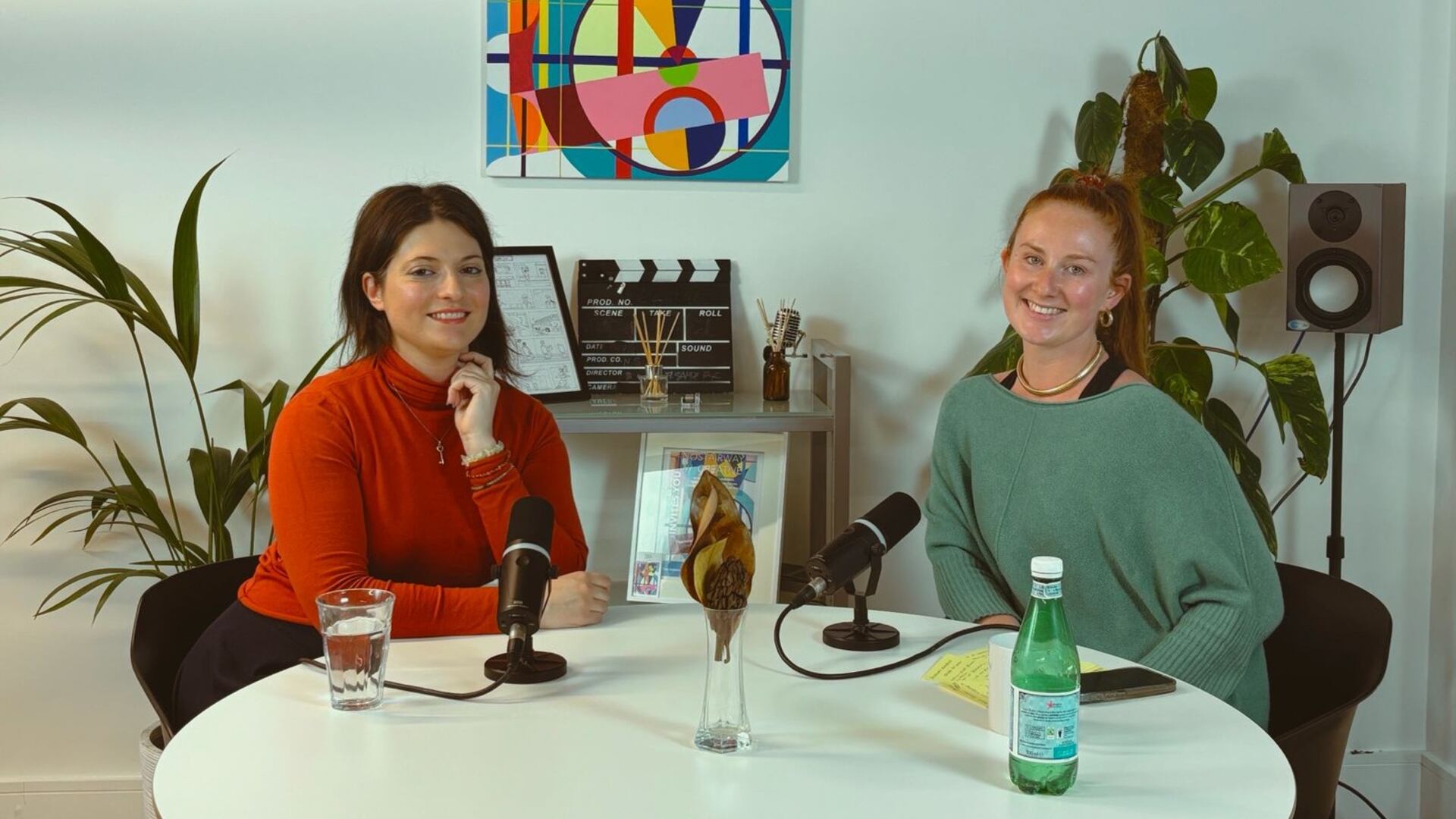
Writer and director Alessandra chats with Imogen about her career in the film industry
Alessandra Gonnella wrote and directed A Cup of Coffee with Marilyn, the short film about the interview Oriana Fallaci never got — and then turned it into Miss Fallaci, an eight-part 1950s period drama shot over six months in Rome. She got there by messaging Fallaci's estate on LinkedIn from film school, talking five-star London hotels into lending her their ballrooms, and winning a pitch competition against a team that included one of Gladiator's writers. Yoreflix founder Imogen Cooper talks to her about doing period drama with no money, choosing which years of a life to dramatise, and the eight months she spent not knowing whether four years of work would ever be seen.
"If you could go back to any period in history…"
Imogen Cooper: If you could go back to any period, as yourself or as a character, what would it be?
Alessandra Gonnella: In terms of a character — Elizabeth Bennet. Probably millions of other women would say the same. Even Nora Ephron, another big idol of mine, who obviously loved Pride and Prejudice. So it's many of us who identify with her.
Otherwise, the Virginia Woolf era, the Bloomsbury Group. I'd love to have a drink with them in a smoky room and argue about feminism.
IC: I studied history and English literature, and I always thought I'd like to sit in a room with the Bloomsbury Group — then quickly realised they would out-intellectualise me and I'd feel insignificant and stupid.
AG: At least nobody would know about it. There was no social media.
IC: True. No memes could come out of it. Is there a film that captures it?
AG: For Virginia Woolf it's The Hours, and nothing else. I watch everything that comes out on that subject, however big or small — there's one still in the works about Night and Day by my director friend Tina Gharavi, and I was lucky enough to see a preview. I've watched Vita & Virginia. But The Hours is one of those films that touches generations, across the globe. Stephen Daldry, and the performances — Meryl Streep, Julianne Moore, Nicole Kidman.
Learning the craft on 5,000 euros
IC: Tell me about your route into the industry.
AG: Funnily enough, almost all the short films I made — even in film school, when I was twenty or twenty-one and just learning — were period dramas. I made very long, very ambitious ones, twenty or thirty minutes, which is still long for a short. They were all set in the 1940s, at the close of the Second World War, because in Italy the resistance to fascism is a deeply felt theme. Every family has a story. Every little town has monuments and squares dedicated to the partisans.
So I shot two short films that were quite similar in period and costume, with some of the same cast, both in the Veneto, where I grew up. That's where I started to learn my craft.
IC: Were they funded, or scrappy?
AG: The thirty-minute one we did for about five or six thousand — but if you look at it you'd think it cost fifty. Everyone lent us things. We found the farmhouse. Really collaborative filmmaking.
That's the interesting part of period drama from the making point of view: you meet all these older people who lend you clothes, lend you their farmhouse. It's the film within the film — the story within the story. So many memories. You feel lucky that people are lending you pieces of their family's history.
And you build a community, especially in little towns where nothing ever gets shot. Oh my God, we're making Hollywood here. People posting pictures in Facebook groups. It was like being in LA.
IC: And that's where you learnt to get production value out of very little.
AG: It stayed with me, right through Miss Fallaci. I'm the least bothered person about budget — not because I'm oblivious. Having made your own shorts, you know exactly what the constraints are. I just think, I've seen worse, I can find a way to cheat and make it look nice.
It's a skill and an attitude I keep even now, when I write. Unless somebody gives me millions and millions of pounds, I try to keep it indoors, in places that aren't crowded. And that makes you focus more on the dynamics of the character, the performance, the vibe of it.
Being critical of the genre
AG: It also made me very critical about period drama. I enjoy watching it, I'm intrigued by it — especially because period drama and biopic often go hand in hand, so it's often about real people, and you go away and read about them. But there are smart ways to do it, and sometimes I watch things that aren't being smart. They're just dressing people up for the sake of it.
IC: Everyone now has to wear all the different hats to get something made. The lines between writing, directing and producing used to be much more clearly laid out.
AG: Somebody has to apply stubbornness somewhere in the line — the producer, the writer, the director, or even the cast. So many actors have production companies now, option books, executive produce. Rachel Weisz, Cate Blanchett. At least they can pull the big budgets.
The difficulty at the other end, as emerging talent, is entering that band. Because period drama is considered an expensive and complex genre, I feel it's still difficult to let new blood in. What I've done is an exception, and I'm all the more grateful for it, because I know it isn't common.
IC: That probably says a lot about you more than anything else.
AG: I was a stubborn person in my line.
IC: You need those people. I'm launching a streaming platform — people do crazy things.
Stalking an estate on LinkedIn
IC: How did A Cup of Coffee with Marilyn begin?
AG: I was still a student at the National Film and Television School, with a few months left, and I contacted the estate of Oriana Fallaci. I was already a big fan, but as a regular person who reads books.
And then I stalked the estate.
IC: We love a good stalking story. It's part of the stubbornness. Let's rebrand it.
AG: Professionally. Just professionally. He'd shown interest on LinkedIn, so I wrote him a message. His profile wasn't even complete — I thought, this is a fake profile, he isn't even visiting it, he's definitely never going to see my message.
But he replied within twenty-four hours. I'd introduced myself as the biggest fan of his aunt's work, saying I was trying to make a little short film about the story of how she didn't meet Marilyn Monroe, which I think is very funny, and which is in her first book.
He called the publisher — a very big Italian publishing house — and wrote a letter giving me permission, for free. He understood there was no profit in it. And because I'd introduced myself as a student, he probably thought it was a school project and not much would come of it.
Then over the following months I kept calling him back. By the way, I've got this incredible celebrity to play the lead. And two months later: I've found a producer. I've found a composer. So he started to realise I wasn't a random amateur.
IC: And presumably then everyone threw money at you.
AG: Naively, that's exactly what I thought. Now I have the star attached and the songwriter writing the music, people will open their chequebooks. Far from the truth. I still had no money — except now I had two stars I had to pay. More outgoings, and still nothing.
Pretending London is 1950s New York
AG: The other important part was getting access to high-profile locations, because we had to pretend we were in Hollywood or New York in the fifties, and we were in London in 2019 with no money. So it had to be interiors that were ready to go — I didn't have a team to redress a whole room. I focused on five-star hotels that gave the fifties, upstate New York look.
Those places are expensive to hire for a day. So I went to the marketing people: this is a great opportunity, people will come and stay at your hotel because I shot here, and the Italian star Miriam Leone will post a photo. And some of them bought it. Some hotel managers said, yes, okay, let's do it.
I still don't know how I did it. The Sheraton Park Lane on Piccadilly gave us the whole ballroom and the whole entrance, which we made look like the New York Times building — if you look at it now, you recognise it. We shot there a whole morning. Then a boutique hotel in Chelsea, which had been a celebrity's house. And the Marriott County Hall, opposite Westminster.
IC: This is what filmmaking should be. It's collaborative, people want to be involved, it's fun. My approach is that the worst anyone will say is no — and often the ones who say yes make a really enjoyable experience, because they're not fighting you the whole time.
AG: In film school they teach a mantra I still use: if you don't have time, you need money. If you don't have money, you need time. If you have both, great, but usually you have one or the other. We clearly had no money, so what I could do was spend more time and plan everything carefully — plan B, C, D, E, F, G.
IC: Belt, braces, piece of string. That was my grandad's favourite saying.
Lockdown, and finding the story
IC: What happened after the short?
AG: The bad thing was the timing. The lockdown started in March 2020, and I escaped to Italy — I went to Rome for what was meant to be two weeks and stayed six months. It was right at the moment the short was picking up, so I was going to festivals online, winning prizes online. Depressing and joyful at the same time.
But I had a lot of time on my hands, so I started developing an eight-part show about Oriana.
At the beginning I didn't know what to focus on. The short was clear — the Marilyn story, a comedy, emblematic, instantly recognisable. But a series? I could have done the whole first book, where she interviews the celebrities. Every episode a new star, a sort of Ryan Murphy Hollywood, but with real people. Then I thought, it isn't holding up. Something's missing to make it a rounded story.
Everything changed when I decided it should be about the journey of a young journalist. The public persona, the people she meets, the pieces she writes — but also her becoming a woman. It was extraordinary of her to travel the world alone in the fifties, and do basically whatever she wanted.
Everyone remembers her from the seventies, when she was forty and went to Vietnam and became a war reporter, the interviewer who sat down with Gaddafi. Very serious, very tough, even the face, even the voice is sharper. I wanted to tell the up-and-coming journey — who was she before she went to war? The glamour, when she was learning even from the celebrities how to be a woman, how to be a journalist, how to establish yourself in a male-dominated environment.
IC: How do you choose?
AG: Selection is crucial. Which period of the life, and why this moment — what happened then, why was it a turning point. Sometimes I watch biopics where they try to put a whole life in, and it doesn't work, because you can't summarise a person and convey any emotional depth. I could just read the Wikipedia page and put it on screen. Drama is more than that. Or they pick a strange moment, when other things in that life were much more interesting, or untold.
Winning the pitch
IC: How did you get it made?
AG: Me and the small producer who'd helped on the short started knocking on doors. Bear in mind we're both from the Veneto, in the north — and Rome is like London for the Italian industry. That's where the production companies, the distributors, the funding institutions and the filmmaking families are. I'd never lived there, so I didn't know anyone.
Many people ignored us, and this was during COVID, so we were not on anyone's priority list. But one company that listened was Minerva Pictures, who had never made a television show before. They were intrigued by the IP — the short film, the topic, the character. So they said, let's try.
We applied to the MIA market in Rome, to the drama pitch competition, and got in. I was competing against nine or ten teams from all over the world, some with big showrunners. The Hollywood Reporter ran a piece beforehand saying one of the teams had the man who wrote Gladiator on it. So I thought, okay, I'm going for fun, I'm not going to win.
MIA gave all the participants a free coaching session with an American consultant who does magic to your pitch — what to cut, what to say, what not to say. I had one or two sessions and I got it perfectly. I rehearsed it. I went on stage. I won.
A big part of it was that we were probably the only team showing a short film. The short was the proof of concept — the pilot. And the lead was a star, so people could see it: oh, this is a show, it's already a thing.
IC: So you had a very tangible proof of concept.
AG: Viacom, now part of Paramount, gave the prize. And during the ceremony they came to me and said: we're not just giving you the prize, we actually want to produce your show, as the first Italian original for our platform, which is launching in two years.
A few months earlier I'd also won the Italian equivalent of an Oscar for the short — announced online, because there was no ceremony. So I arrived at the competition with the prize, and the short film, and the star. A nice package. People thought, let's bet on it.
Six months, and a street in Sofia
IC: How long was the shoot?
AG: Six months — January to July 2023, eight episodes, all in Rome or the Rome region. Again pretending to be LA in the fifties, New York, Paris. That skill set came back.
The one thing I fought for, with the other directors, was London. I said, the only thing we cannot shoot in Rome is London. Maybe the interiors, but we had exteriors to do, and architecturally there's not one inch of a wall in common. It's funny — here there's a Little Venice, and in Rome there's a little London, one street in a very posh area where the houses look like Chelsea, with the steps and the columns.
Production tried to get away with it. No, no, no. And luckily we went to Sofia, to Nu Boyana Studios, which has New York and London streets — I knew about it because I'd already researched it for the short. So I complained, but I also gave the solution. We shot there on the closing days, so we ended a six-month shoot in Bulgaria. A very exotic experience, and the exteriors look legitimate.
Eight months in limbo
AG: It was delivered by December 2023 and was supposed to come out around spring 2024. Then Paramount+ announced they weren't premiering it, along with some other shows — cutting programming, changing strategy. They said they'd distribute it on other networks.
Emotionally that was tough. From that moment I spent eight months in limbo, not knowing if or when the show I'd spent four years on — my only credit to this day — would come out.
By the summer of 2024 I got the insider news that it was going to Rai in Italy, which is the equivalent of BBC One. So I instantly knew millions of people would watch it, across all ages and demographics. And then that we'd premiere at the Rome Film Festival in October, which we did. I walked my first red carpet. Felt like a star.
What gave me the biggest boost was the young journalists interviewing me saying, you're the first young woman I've interviewed like this — you're an inspiration for us. Initially it didn't occur to them that I was the director. And it's been great to see people, especially younger people, getting interested in Oriana Fallaci again.
"All I can say is I'm available"
IC: It shows how long it takes to get things off the ground — and how one change at the higher levels can take the premiere away.
AG: If I could direct another period drama, that would be fantastic. One thing I find, and maybe it's a bias people hold, is that when you talk to British producers about a British story, or a British character — Virginia Woolf, Jane Austen, whom I love and have studied deeply — sometimes there's a question of why you would be trusted to tell a British story if you aren't British. They don't tell you that, but I think it can be a prejudice about the legitimacy of telling one story or another. And first of all, directing is a visual medium.
All I can say is that I'm available, and I love anything period. Maybe military a bit less, because of the violence and the war. I prefer tea parties, love stories, balls, dances, declarations of love in the rain.
IC: I'm all for more period drama coming into the world — that's why I'm doing what I'm doing. Perhaps we'll work together, and I'll steal you for a Yoreflix commission.
AG: That would be lovely.
Alessandra Gonnella's A Cup of Coffee with Marilyn is available to watch on Yoreflix. This interview has been edited for length and clarity.