
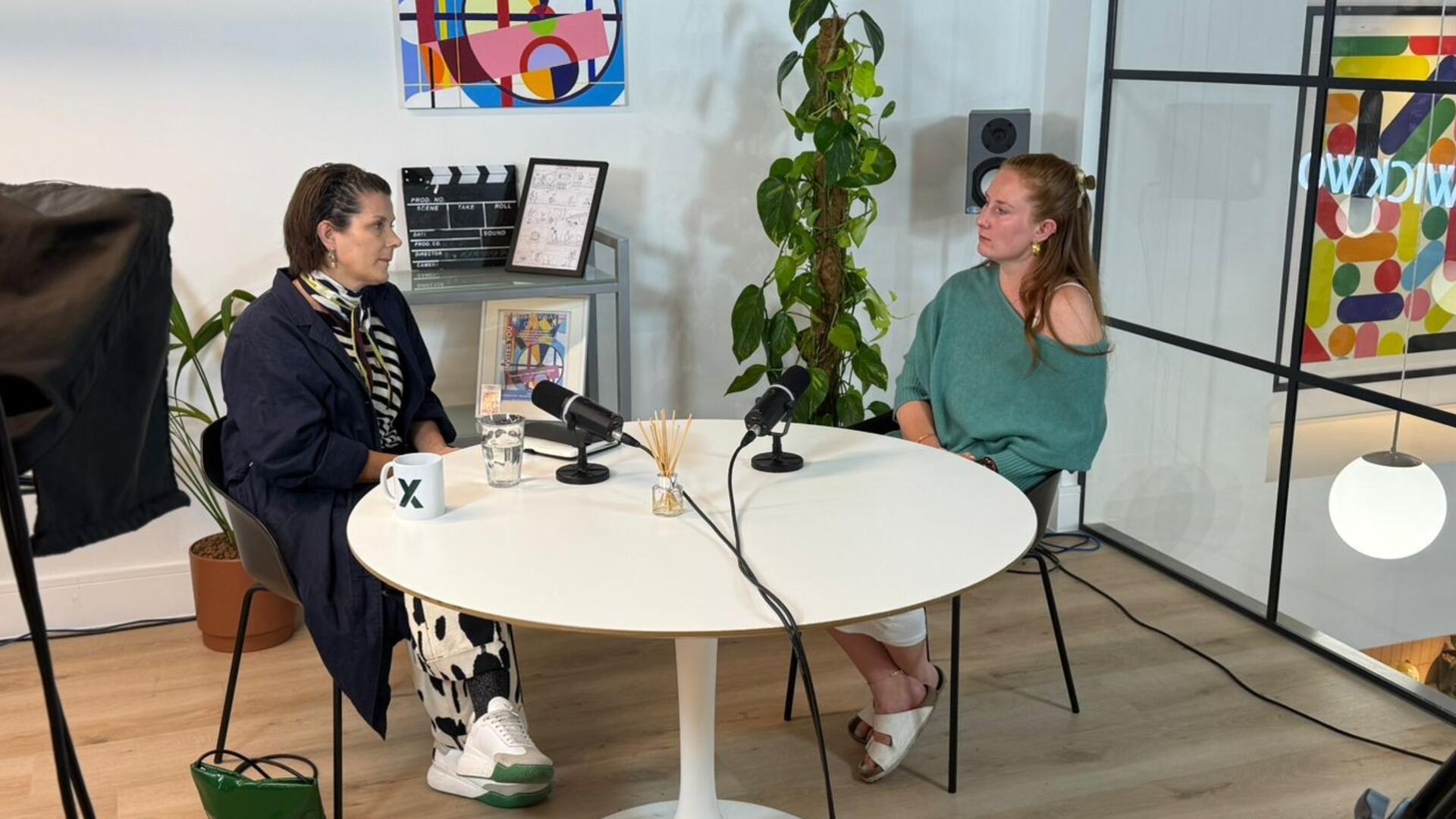
Costume designer Emma Fryer discusses her career in the world of film costume drama.
Emma Fryer designed the costumes for Lady Chatterley's Lover, The Great and The Hustle. She got there from a metal corset made in a Wolverhampton degree show, by way of the Royal Opera House, a laundrette in France trying to get molten tarmac out of six lime-green velour dresses, and a phone number for Leigh Bowery scribbled on a piece of paper. She talks to Yoreflix founder Imogen Cooper about saying yes before you can drive, why the shape of a period is fixed and the fabric is not, and buttons.
"If you could go back to any period in history…"
Imogen Cooper: If you could go back to any historical period, as yourself or as a character, what would it be?
Emma Fryer: The 1950s. I love the outfits — it's the shape of them, and the change. After the war, the whole New Look. And then going from the early fifties to the late fifties, you go from that amazing shape to a whole other wonderful world.
You've got the little wasp waist. And I think it's such a great period on every female body shape — it still looks amazing. It's very feminine, which is very different from how we dress now.
IC: I kind of wish we still dressed like that. I'm very not on board with the parachute-trouser situation.
EF: There was a real glamour about it. Accessories were still important — the gloves, the handbag, the hat. A real sense of chic, and a pride in how you presented yourself.
A metal corset that bought a car
IC: You have an interesting route into the industry.
EF: I didn't do the A-levels that would have been helpful — history would have been great. Then I did an art foundation course, which is quite a normal route, and it's such a great year for discovering where you want to go.
I got slightly talked out of theatre design and into 3D design, on the grounds that theatre design is still three dimensions if you're doing sets. I was looking at a college up near Wolverhampton, and on the train back I thought, this is crazy, I should get off and go and see what's actually going on there. It was about six in the evening. I went in and there were still students working, and they were so enthusiastic about the course.
So I did three-dimensional design — wood, metal and plastics. In my last year I made metal headdresses. And a corset. In metal.
IC: I bet that was cool.
EF: It bought me my first car. It went on a touring exhibition for a year called Unlaced Grace — ten corsets, including a Vivienne Westwood, and one by Whittaker Malem, who are still in our industry and do beautiful leatherwork. At the end Banbury Museum bought three pieces, and mine was one. I think I sold it for about a thousand pounds, which seemed like a lot of money then.
IC: I paid for my first car working at probably illegal rates in a farm shop at thirteen. I'd much rather have made a metal corset. Have you seen it since?
EF: No. Who knows if it's still in the basement of Banbury Museum. I have a great photograph of somebody wearing it.
IC: If you ever find where it's living, I volunteer to try it on.
Phone calls from a head of department's office
EF: So I thought, what am I going to do with my metal corset and my metal headdress? It isn't quite a job. I spent some time on the phone in our head of department's office — probably sneaked in — making all these calls. I don't even remember how I got the numbers. And somebody said, you should contact Martin Adams, who was and still is a costume prop maker in London.
I had a really nice chat with him, explaining what I was doing, and he said: when you come to London, come and see me. I kept in touch — nearly in London. I'm in London now. Hi, I'm here. And I went to meet him at a great workshop at the end of Lots Road. Which meant a fantastic trip down the King's Road, pretty amazing for me — I'm originally from Bristol. Looking at all the shops thinking, I can't afford anything, maybe one day.
This is about 1992. He was working on Little Buddha, where James Acheson was the costume designer, and he had a team making jewellery and metal pieces. I arrived, showed him my portfolio, and got myself a job for about two months in this amazing studio with about ten other people.
IC: That came out of nowhere.
EF: Then it finished, and it was: what am I going to do now? I don't know how I even got to meet people. It was so different then. Now it's easier, but harder in another way, with email and the internet.
IC: We've lost that in-person thing of meeting someone and it leading on to something else. I'm still quite good at getting into rooms and making friends — that's how I choose to live — but I don't think many people do that now, or know how to just roll with things happening.
EF: I think I had the energy, and I really wanted to move on, and I was in this new big city. But even now I probably wouldn't.
I walked into Vogue with no appointment. Jasper Conran was in the lift — the only person I recognised. I went straight to the top floor, had a conversation with somebody at the desk, showed him my portfolio. Isabella Blow was in a meeting room in the corner. They kept my portfolio for a couple of days, because she was doing a half-page spread about insect-related design and my corset looks a little bit alien. It never got in, because it wasn't for sale anywhere in London.
I met Andrew Logan — I remember going to his place at London Bridge and there was a full-size horse he was covering in broken glass.
Meeting Leigh Bowery
EF: And then I met Leigh Bowery. I had no idea who he was.
IC: For the podcast — who was Leigh Bowery?
EF: A performance artist in the eighties and nineties. Incredible costumes. He was part of that whole club world — Boy George, the Alternative Miss World. He'd turn up and you wouldn't even see his face, with a big bobble head. And he did mad, crazy, amazing performance pieces.
I had this thing in my head, because I'd seen a double-page spread in a newspaper about Michael Clark, and I thought: I've got to get this man into my corset. I'm not a dancer, I didn't know about dance. But I must have said it out loud somewhere, and somebody said, you should meet Leigh Bowery, he makes Michael Clark's costumes. Here's his number.
I was living with my school friend, who was training at Guy's, and some dentists, near Tower Bridge. I left a little note by the phone saying: I've gone to meet this man called Leigh Bowery, and if I don't come back, this is where I've gone.
Lucian Freud did the most amazing paintings of him. When he wasn't in costume, he had two ball bearings in his cheeks. I met him, showed him my portfolio, had a nice cup of tea — he'd just come back from Paris. Nothing came of it. And at the time I didn't realise what an amazing person I had just met.
The Royal Opera House
EF: Then, madly, I ended up at the Royal Opera House in the props department. Someone there told me the millinery and jewellery departments — which had been separate — had just merged, and they were looking for somebody. I found the first red phone box I could on Caledonian Road, rang up, and got an interview. And I got a job at the Royal Opera House.
I'd never seen an opera in my life. I'd tried contemporary dance on my degree — a friend and I thought, you're at university, you can go and do a karate class, let's try contemporary dance. We were so bad. It lasted a few weeks.
IC: I love the Royal Opera House. Ballet is my thing.
EF: The audiences are totally different, ballet and opera. And I hadn't been to an opera until I worked there — I think everyone should. When the whole chorus comes on, it's an incredible experience.
I think what got me the job was that I'd done some odd wire things in my portfolio, and all the ballet headdresses are wire frames. Somebody else joined not long after, from the Royal College of Art, and her millinery work was incredible.
It was a magical place for a first job in London — working in Covent Garden every day. And it's amazing because you walk into this place and all the technicians are making your designs come to life under one roof. The dye workshop, the props workshop, the scenic painters, the wigs and makeup. It was all there. I used to love going into the armoury.
Designers came in with all their different drawings — some with no drawings. One designer's costume drawings were paintings. I remember going in on a Saturday to finish a headdress for a ballet, and she came in, opened her handbag, took out a bit of rag and said: we're going to make a headdress with this.
"Can you drive to Italy?"
IC: When did the shift to film and television start?
EF: I still had it in my head that I wanted to be part of designing everything, not just the headdresses and the jewellery. That never left me.
Then I got asked, out of nowhere: can you drive, Emma? We had a designer in, Maria Björnson — an amazing designer, sadly no longer with us — doing a new version of Sleeping Beauty. And a supervisor helping her asked whether I could drive. I said yes. I hadn't driven since I passed my test.
Can you drive to Italy? Can you drive Maria Björnson and be her assistant?
It was somewhere called Batignano, where two men had bought a monastery and used to put on two operas a year. So — could I drive to Italy with Maria, and Dexter Fletcher, and his partner Dalia, who was directing. I said yes.
Thankfully I didn't drive in the end, because Dexter didn't get the car sorted out, which was a huge relief. We flew — and then I forgot my passport, and amazingly got one at the post office at the airport before the plane.
IC: A lot of people would have stopped themselves saying yes to that. The art of just saying yes and figuring out the next bit is a dying art, and I love it.
EF: A friend took me out in the car in Brixton and said, you were so bad. I could never have driven to Italy. I couldn't even drive down the road in Brixton without people beeping.
Maria was the most special, incredible woman. And afterwards — I remember being in the National Portrait Gallery bookshop, and somebody tapped me on the shoulder, and it was her, and she said: Emma, you'll never be a designer if you stay at the Opera House.
Motley, and Sandy Powell
EF: So my head went back to the one-year costume and set design course I'd been told about, Motley. I applied, and amazingly got some money from the Laura Ashley Foundation — not loads, but it really helped.
It was an incredible year. There were only ten of us. We were year 30. Alexandra Byrne came through there. It doesn't exist any more, sadly. Margaret Harris, who started the course, was ninety when we were there in 1995 — an amazing woman.
Before that, someone had introduced me to Sandy Powell. I'd met an amazing person called Simon Costin, who did theatre design at Wimbledon and whose career is incredible — he ended up doing sets for Alexander McQueen. Simon saw my portfolio and said, you should meet my friend Sandy.
Six dancers, three Saabs, and molten tarmac
EF: I left the Opera House because Sandy was designing for a dance company. She'd met Lea Anderson at Central Saint Martins. Lea set up a company called the Cholmondeleys, and later a male company, the Featherstonehaughs, and Sandy costumed a lot of their shows.
I went on tour as the wardrobe mistress — the only one — when Lea wanted to take dance out of the theatre and into the outside world. Six dancers, three sections, and we went to France.
Saab sponsored it. The dances were all in and around the cars — three Saabs and a van, with the costumes and props in the van and the dancers travelling in the Saabs.
The first section, they were all in green velour dresses with hoods and long sleeves, and trainers, hiding in the cars. Then they came out and peeled the dresses off, and underneath they had silver jumpsuits. And they jumped all over them. I don't think Saab understood why the cars came back covered in dents — they'd assumed an all-female troupe would just be sort of decorative.
The next section was a homage to people who had died in car crashes, so they were in little pink Jackie bouclé suits. The last was a kind of Dadaism, with three of them dressed as men wearing their suits back to front and the others in thirties dresses.
But in France the tarmac melted. It went all over the car, and all over the green velour dresses. I won't forget sitting in a laundrette in France on my own, watching them go round, thinking: how am I going to get this tar off these costumes?
IC: I'm such a visual thinker, and I'm picturing this as you say it. This should be a film.
EF: Lea Anderson is an amazing, spirited person. To her, the costume and the visual of dance were really important — so having Sandy design them was a really important part of the show.
Shakespeare in Love
EF: After that job I went to see Sandy, who was filming Michael Collins. I remember going over to Ireland, and her saying, come and meet me at six o'clock in the morning, and thinking: six o'clock in the morning. We went to set and then back to the costume base, and they had a huge scene in a football stadium with over a hundred rails of costume. I could probably have stayed and worked on it — but I'd already said I'd do the one-year course at Motley, so I followed that through.
My first design piece afterwards was a David Mamet play in a theatre above a pub — build and costume and set. Then I was at Angels helping to costume a Victorian Christmas event, and I remember being there quite late and hearing somebody rustling down the corridor, and it was Sandy.
Just after Christmas I got a phone call asking if I'd like to work on Shakespeare in Love.
IC: Oh my gosh. That film is probably one of the reasons I've ended up doing what I do. There's a video clip of me at about five or six, prancing round my parents' house saying, can I watch Shakespeare in Love with my breakfast? — and my mum in the background saying no, not without Mummy and Daddy, because they had to fast-forward the raunchier bits.
EF: I remember having to take something to Joseph Fiennes's house, and saying to Sandy's assistant — should I hand-deliver it and make sure he opens the door, not just post it through the letterbox? No, you can just post it through the letterbox. Are you sure?
The prep time wasn't very long. Sandy's assistant had come off Elizabeth, which really helped, because period-wise it was similar and we had to source everything very quickly.
I was there as a junior buyer, so I was out and about a lot with a very long list. Buttons and trim and fabric. I remember taking fabric down to Worthing for one of Dame Judi's dresses, and having to hand-deliver that, racing down in my little red car. I just remember running around a lot.
And sourcing costumes for the crowd. I went to Bristol for the day to see what they had. Now we look further and go abroad a lot — if you're costuming a hundred, you might go abroad for your crowd. Then we were looking at Stratford, at Bristol, still within the UK, for the background artists.
It was quite an unimaginable experience. There was a lot of location work, some of the most incredible houses. But equally, walking onto a beautifully built set, with beautiful costume — I think it's magic.
Mood boards, and reading the script
IC: Do you still get that feeling now?
EF: You definitely do. Every project might be different and every project is a new period, so as a starting point you have to familiarise yourself with the period again. Unless all your work is the 1950s or the 1920s, you're jumping back into a new world.
The beginning is reading the script, which at Motley was always talked about as such a big thing. And it still is, because a great piece of writing is so important to everyone doing a great job — not just me, but the cast and the other heads of department. You're sent the script before you have a meeting, and it's nice to read it without any thoughts and just enjoy it. That's a big telling point: if you're loving it, and visualising people and characters and clothing.
There's a whole new world now. There have always been references and research — I helped with research on Gangs of New York, and that was A4 files, going to find books and magazines and photocopying them. That's still important, but mood boards are a new world. In my early career I'd go in with a portfolio of work I'd done. Now you're asked to present visuals when you haven't actually spoken to anyone — you haven't spoken to the director. Give five people the same script and five people would have a different visual.
IC: One of my favourite parts of executive producing is talking to the costume designer. I love how costume feeds a story and brings characters to life — the aesthetics, the colours, the palettes. And you're right, now it all starts with the mood board. I have absolutely said, do you have a mood board?, many times.
EF: I really enjoyed doing the boards on Lady Chatterley. That's quite a telling thing — if you're having fun and really getting into it. And one thing I always felt about that job was that the boards came to life. Sometimes boards shift once you're on a job, or change a little. I don't think they did on that one. If your gut feeling stays true to what you had at the very beginning, that's always great.
Lady Chatterley's Lover
IC: How did you balance it — a specific period, a literary classic, an earlier classic film, and Emma Corrin as a new star? Was there a focus you leant towards?
EF: Laure, the director, had her feelings about it. There was a sense she wanted it rooted, but with freedom too. So you're taking on the conversations you've had with the director.
At any period level you still start with the period. There are original period pieces in the costume houses, so you can go back to beautiful originals. And then, as we know, fashion always goes back — there are blouses you could have bought this summer that are still influenced by the teens, slightly changed, different fabrics, but rooted. Within periods, we are always looking backwards and slightly changing it.
So I started with the real period, and then looked at what was in the shops, in the fashion world, when we made it. There were blouses and skirt shapes we could use. And then I set up a workroom — so it really was a mix of hiring, making and buying.
It's still so character-driven. Even on a contemporary job, it isn't a case of just buying a dress — that one dress has to be right for who the character is. So it's the journey the character is on. At the beginning of the film everything is quite restrictive, there are a lot of rules, everything is buttoned up and the fabrics are wool and thick. Then, slowly, as she meets Mellors and her whole world is changing, everything becomes looser and the fabrics are very different. There's a lot you bring into costuming to tell the story — but it's what's right for Connie, for who that person really is.
The Great, and thirty buttons
IC: How was The Great? It's very playful — one of those in-between things, based on history but obviously playing with the genre.
EF: The shapes of the period are the shapes of the period. And that's interesting, because in how we dress now there are so many different ways of wearing clothes, so many styles. In period there were fewer — people's wardrobes were nowhere near what they are now. You had your Sunday best.
So it's: can you play with the shape slightly, can you change it? But more than anything on something like that, it's the fabrics you choose, and how you play with them.
I always talk about buttons on The Great, because the buttons drove you nuts. The men's coats needed about thirty buttons each. You'd end up somewhere amazing in Brick Lane or Portobello, see someone with a button stall, find a button you really loved — and then start counting, and there just aren't enough. The buttons, the linings. That's what was so brilliant about it: you could have fun with it.
And Lady Chatterley was the same. There were costumes Emma had that she could wear out now and nobody would blink.
Favourites
IC: Aside from your own, what's your favourite period drama for the costumes?
EF: I worked on the first of the new Star Wars films — The Phantom Menace. I was in the workroom. None of us thought we'd be working on that. I remember when Chewbacca walked in.
IC: My only foray into making my own clothes was trying to recreate Padmé's outfits, and making my younger sister parade around in my attempts.
EF: So that one, and Shakespeare in Love. Then there are things like Rear Window — Edith Head, and those costumes are fifties, and beautiful. Baby Jane, completely different. And films that influenced me when I was younger: Gone with the Wind, and that huge dress. The Wizard of Oz. Ben-Hur left a massive impact on me as a child.
But Grease — my dad took eight young girls to see it, and the queue in Bristol went all the way round the cinema. Films like that leave something. Her leggings at the end, and the transformation.
This interview has been edited for length and clarity.