
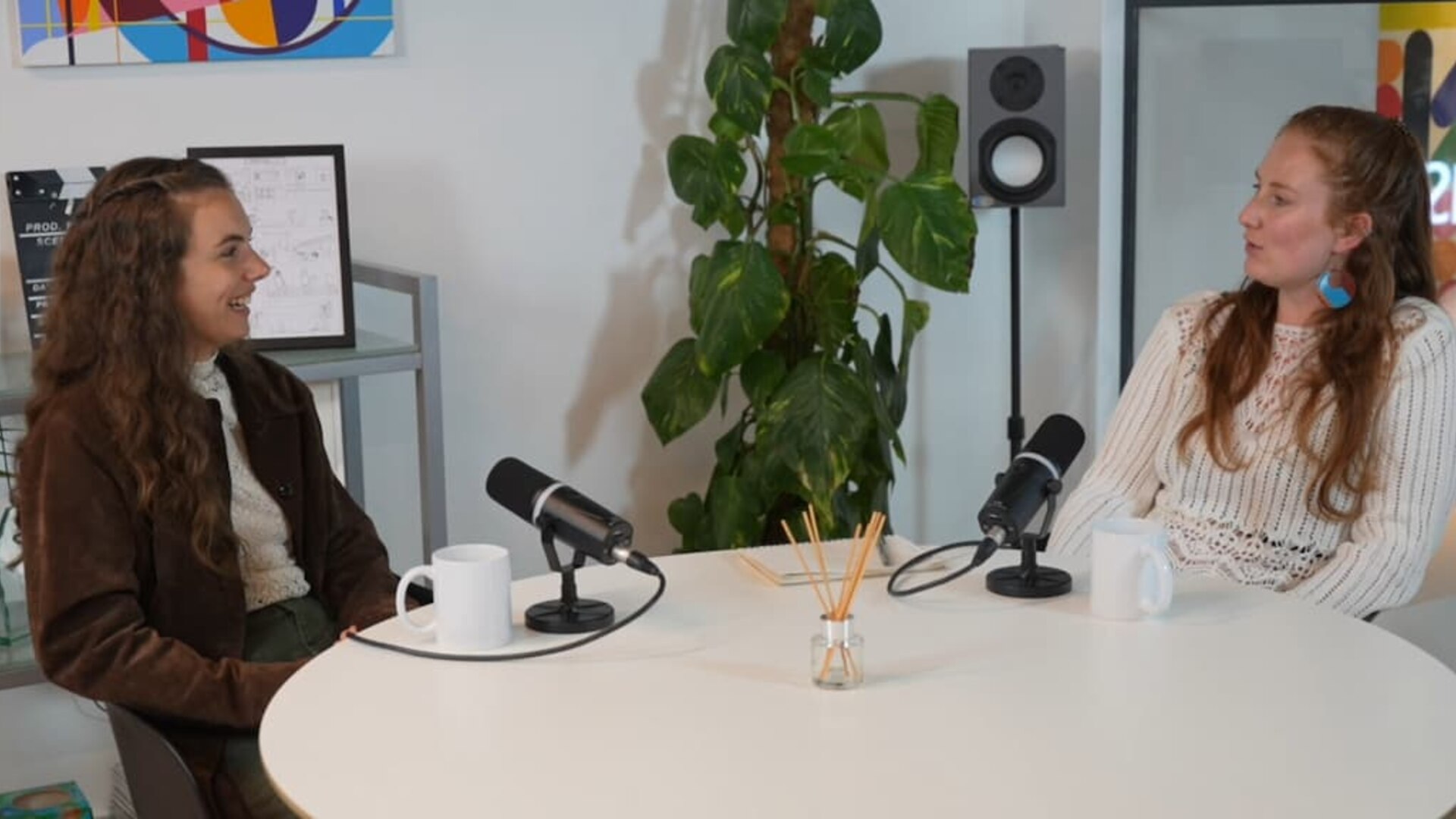
Producer and actor Jennifer James discusses the making of her short film 'The Newspaper'
Jennifer James has acted in Victoria, David Copperfield, Gentleman Jack, The Crown and Peaky Blinders, and has produced eight short films back to back since 2020. She started as a supporting artist because casting told her she had "plain features" — which she took as a compliment, because it meant period drama. She talks to Yoreflix founder Imogen Cooper, a friend, about corsets at five in the morning, why an actor hid an apple on the Peaky Blinders set every day, and what it takes to build a career when the answer keeps being no.
Eight short films, back to back
Imogen Cooper: You've made seven short films now?
Jennifer James: Eight, actually — the newspaper one was the eighth. Back to back, about three or four months' turnaround on every one.
IC: People probably don't realise what a feat that is. A lot of people's whole career is trying to make one short film.
JJ: They're not all good.
IC: No — we're being far too self-deprecating here. They're all very good.
JJ: It goes back to just having to make it. I was talking to a filmmaker recently who said people sometimes see speed as a negative — you're being too quick, you're not being patient. But elongating the process can shoot you in the foot, because you overthink it, you over-edit, and it becomes a circle of never being enough. Three years go by and you still haven't made anything, and the script you started with is completely different.
Sometimes the story you set out to tell is the thing. If you keep changing it you'll come full circle back to the original. Trust your gut and stand in it. You need to edit and make it better — but get it out there.
"You're perfect for period drama, because you're so plain"
IC: You've been in quite a few period dramas.
JJ: Victoria, David Copperfield, Gentleman Jack. The Crown, recently. And Peaky Blinders.
It's funny — at university, when I was studying film and drama, I started doing supporting artist work, and I only ever got cast in period stuff. Because if you're doing period drama they need no dyed hair, really plain features, plain hair.
IC: That is horrendously self-deprecating.
JJ: It's true, though. Every time I'd go they'd say, you're perfect for period drama, because you don't look —
IC: Because you're so plain. I'd have died on the spot.
JJ: I took it as a compliment. I love period drama, so — cast me in all the period dramas. And I kept getting called back. All the BBC and ITV ones were period dramas, so there was a lot of work.
Where the period dramas went
IC: There was a real heyday of period drama on BBC and ITV that doesn't really exist now. Wolf Hall had to be fully produced and made without a pre-sale from the BBC. Everyone assumes it had one. It didn't.
JJ: And Peaky Blinders is with Netflix now. Victoria too. They all got shuffled over. I think Gentleman Jack got picked up elsewhere for the second series — when I was on the first they were umming and ahhing about another one.
IC: A lot of these shows don't have a UK commissioner or a pre-buy any more, but they're being pre-sold in the US. You've got PBS Masterpiece and the rest — which is hilarious, because it's shifted from the UK being the home of period drama to you can watch that in the US?
JJ: The US loves period drama. When I was on Peaky Blinders, that show was huge over there — I had people texting me from the States. My mum has family in America, and when she told people her daughter was on Peaky Blinders, they went crazy for it.
IC: Same in Canada. When I was working between the UK, the US and Canada, all my Canadian colleagues were obsessed with it. And half the social media pages and Reddit threads I follow are people asking: why are all these shows only available in the US, why can't we watch them here?
Snacks, and a hidden apple
IC: Do you want to do some name drops?
JJ: I met Suranne Jones on Gentleman Jack. Loved her. I sat behind her in a church pew for an entire day and she shared her snacks. Everyone was sitting there, and she was the one allowed to move, and she said: do you want some dates, or some nuts?
IC: You can tell so much about an actor from the snacks they offer on set. As soon as I've been on a set for any length of time the runners work out that I'm a mini party ring woman. Everyone else is having an apple or some dates and I'm shuffling packets of mini party rings like an addict.
JJ: I also met Cillian Murphy. Loveliest guy. And yes — his eyes really are that blue.
I'm terrible, I don't know all their names, except his. And I hadn't seen the show.
IC: Does that happen a lot as an actor?
JJ: Unless you're auditioning for a bigger role, where I'd watch an episode or two to get familiar. I had watched one or two, just not enough to know.
We were at the Garrison — a set build at the Manchester studio — and we sat outside, because it was winter, with a heater and hot water bottles, all our chairs round it, waiting while they set up. And I did say, I'm sorry, I don't actually watch the show. It handed itself over to another conversation, and they were really great.
But one of the funny things one of them did, before every take, was eat an apple and then hide it somewhere on set. Production design would go: he's done it again. They'd have to do the checks and find it.
IC: If you've been one of those main characters for years and years, you must get to a point of thinking, what can I do to entertain myself here?
Corsets at five in the morning
IC: What does it feel like to be in period costume?
JJ: If I could just be a character actor cast outside the modern, hands down, that's the trajectory I'd want.
It takes much longer. On Victoria, Gentleman Jack, all the corseted ones, call time was 5 or 6am and I'd be in the chair two or three hours. I have really long hair, so for an updo they have to curl the whole head. Then you go into wardrobe and you've got about three people dressing you, because there's a big petticoat and a corset, and you can't even tie your own shoes.
But I love it, because while you're going through that process you're getting into character too. You can do all the work you need to do, and then as soon as you're in the costume it takes on a life of its own. Especially in a corset — your posture is there, you feel proper. You're not in your own world any more. And when you get de-rigged you come back to reality and think: oh, I was just transported to a different time.
Stepping onto the set is incredible for what production design does. We did a lot on location, and whole streets are transformed — you walk back in time, and there are horse carriages. We shot in York and Hull for London, because in the old city centres they redo everything on the cobbled streets.
For David Copperfield I was a prisoner with my husband, and they threw us in the back of an old prison box on a horse carriage, on the hottest day, and locked us in.
IC: Do you ever sit there and think — most of the population are in offices right now, and I'm in a makeshift period box in this outfit?
JJ: It's really funny at lunch. In period costume they're stricter about what you can eat, so they give you these massive bibs that look like bin bags. Everybody is bibbed up at long tables, eating lunch, looking at all these period people.
IC: I asked Kevin McNally on another episode whether they'd go out and about in costume, and he said: are you crazy? We would not last two seconds out in the real world.
JJ: At the start of my career I was mainly on period sets, so when I went onto a modern one I was taken aback — you're not in the makeup chair for long, and I thought, are you doing enough? Now, on a more modern production, I can find it quite boring. Period drama, you get to play. It's dress up a little, which helps make a character, because you step out of your comfort zone.
What still counts as a period?
IC: I normally start with this and we've gone completely off track. If you could go back to any period, as yourself or a character, what would it be?
JJ: I've been doing so much in the seventies space — I have two films set then. The music, the style. But the nineties would be really fun too.
IC: You've hit a controversial topic. I get told off about the 1990s. Someone commented on one of our Instagram posts: surely not the 1990s, vest tops and low-rise jeans are not costume drama. People get very angry. But on one of our TikToks, when I asked what counts, someone said, I've just finished my A-levels and we studied British history from the 1980s to 2007, so that's my personal cut-off.
JJ: 2007? Surely that was last year.
It's also about when you were born. If something is before your time, it's the past — a time you don't know about and are learning history about. But the 1990s has such a distinct feel. For me it's the last distinct period before it hits 2000.
IC: I wonder how long before the noughties has that same nostalgia.
JJ: I think it already does in some ways. But for me it's still blended with the nineties.
If I was going really wild with it, I'd go back to the Victorian era — maybe just because I've been in it so much. Why don't we dress like that any more? They wore such elegant dresses. You watch Bridgerton and the gowns are so lovely and they get to go to balls. Can we still do that?
IC: That's why people love period drama — you're transported to times that are more romantic than modern life. We don't get to dress up and go to balls.
JJ: Although we glamorise it. There was obviously poverty and suffering that wasn't beautiful. You do that with every period — even the nineties or the seventies, there's so much going on socially, and you cling to the aesthetic.
IC: Did Victoria feel glamorous?
JJ: Yes and no. It's funny as a supporting artist — when I first started I was always cast as someone in poverty, so I wore the rags. Then you go to the riches. You had to earn your way up the ladder before they could see you as someone of high class. You go in and there are the racks — the upper class, the middle class, and the poverty people. And when you get your character you think: finally, I'm not in the poverty.
The ones based on a real representation of a person do try to integrate that feeling of, this was real life, and there were people who were poor. In Bridgerton you never really see the lower class. It's all ball gowns and marrying handsome people — which gives a bit of a false representation. But it's television. It's inevitable.
Poldark, and a full-circle moment
IC: Favourite period drama?
JJ: Poldark, without question. I've rewatched the whole series so many times, and I have the book with the full scripts in it. I watched it through university — and then, in 2023, a really strange full-circle moment: I produced a short film with Poldark's son. The boy who played his son in the show. I had a bit of a fangirl moment.
IC: There are a few actors from period dramas I'd probably pass out on the spot if I met. I'm saying now, for the record, that Aidan Turner is one — so if I do pass out, I did warn everybody. And the two from the BBC Robin Hood: Lucy Griffiths, who played Marian, whom I mention in probably every single podcast. If she ever sees them she'll think I'm mentally unstable and get a restraining order.
There's a real comfort in rewatching shows like that, and I can't think of anything recent with the same rewatchable comfort factor.
JJ: They all have a slightly contemporary edge now.
IC: The tone and the atmosphere of those old-school period dramas get cut through by something more contemporary.
JJ: If you look at Bridgerton — the first season was really great, because it followed the traditional viewpoint of the time, the chaperones, the elegance, not wearing a lot of makeup. And then as the seasons have gone on, people were talking about this, especially in season three: you could see gel nails, and the makeup was more lavish. People catch on. I think the idea is to make it contemporary so audiences feel connected — but you're doing yourself a disservice, because the reason people come to period drama is to go back in time.
I loved Poldark because they really capture the scenery of Cornwall. It isn't drama for the sake of drama, it's a slice of life back then — the landscape, the mining, the pirates.
IC: These older period dramas have a softness. Whereas now the colours are so bright and sharp and everything is so slick that it doesn't quite match the tone. That's one of my bugbears, along with contemporary language in period drama — if someone says something in a modern way I think, hang on, we're not in the 1500s any more.
Producing, and starting before you're ready
IC: How did you get into producing?
JJ: I started acting for television and film at fourteen, and that was all I could see. I didn't know there was a whole other side to making a production.
Then at university I fell into production — and going on sets as a supporting artist, seeing this massive BBC production with all these people running around. I was so naive I thought, that person will cast me. But I was fascinated by how many people put work into making a production happen, and I thought: how do I get my hands in here and find something that isn't just acting?
So I did production at university, learned to write scripts, worked out what I was good at. Moved to London when I graduated in 2019, freelanced on a lot of productions, and started my company in 2020 — because when you're freelancing on other people's productions you start thinking, I wish I had control of that.
Filmmakers don't learn business skills. I listened to so many podcasts about how to make a company. I still don't really know — I'm learning as I go. The best quote I've heard is: just start, and perfect it on the way. You can never be ready.
It took a year after my first short to make another, because I had no idea what kind of films I wanted to make. And funnily enough I fell into period with Curiouser, which was a Victorian-ish style. I love setting films in ambiguous time zones.
IC: It's escapism.
JJ: Every storyteller's dream is to transport somebody somewhere really cool, or somewhere we don't have now. And as soon as Curiouser happened it was back-to-back productions for three years.
Double Take, and holding your nerve
IC: You've also founded Double Take Newspaper.
JJ: Going back to period — I'm going back to the newsies. It came out of the newspaper short film we did, set in the 1950s. But it's about something tangible you can read, and a platform for emerging filmmakers to have a voice as they come up.
Social media is a highlight reel. You post the award and a caption saying thanks — but you don't see the work behind it, or the build-up. That's what the newspaper lets people dive into.
IC: You're pretty well known on LinkedIn for posting the reality of the industry. I opened my phone once to a notification saying this person and 160 others had commented on your post.
JJ: Over 100,000 impressions, and thousands of reactions.
IC: Because people are so interested in how things are actually being made right now. And the reality is a lot of chicken and egg, and having to hold your nerve. People say to me, you must have some balls to launch a streaming platform — and you are honestly the only person I've met with a stronger stomach for it than I have.
JJ: If you're getting a lot of resistance and pushback, you're usually on the right track, because you're going against the grain. At the beginning it's really hard when everybody says no. You grow thick skin as an actress starting out, where it's no, no, no, no — and then you make your company and it's no, no, no, no.
I've come into this year with a new mindset: it's a no, great, I'm on the right track. People say, that sounds crazy — great, it's a good idea. Even if that's a delusional mindset. A lot of the time when people push back it's because they didn't have the idea first. Holding your ground is how you go really far in this industry.
IC: We're both in our twenties, and we're experiencing the industry very differently from people who've been in it twenty years. I find it almost funny that the only way for me to get the period drama I'm passionate about, and for you to make the films you're passionate about, is that I've had to launch a streaming platform and you've had to spell out on LinkedIn just how hard it is.
Exhibit A
JJ: Period drama is harder to get made, because of the money and because it's stylised and you do need a good researcher or historical perspective. But my favourite case study is Lady Macbeth, with Florence Pugh.
IC: Such a good one.
JJ: Made for half a million, made five million off the back of it, and launched her career. If you're ever down in the dumps about making period drama, go and case-study that.
IC: Exhibit A. And there's a nice link, because that was Altitude, where I worked for a while. It's a good case study because it speaks to how films can get made and do really well whatever shape or size they are. It doesn't have to be a big action film to resonate with people and get them into cinemas — which, you know, is what films are for. Everyone seems to have forgotten that a bit.
This interview has been edited for length and clarity.