
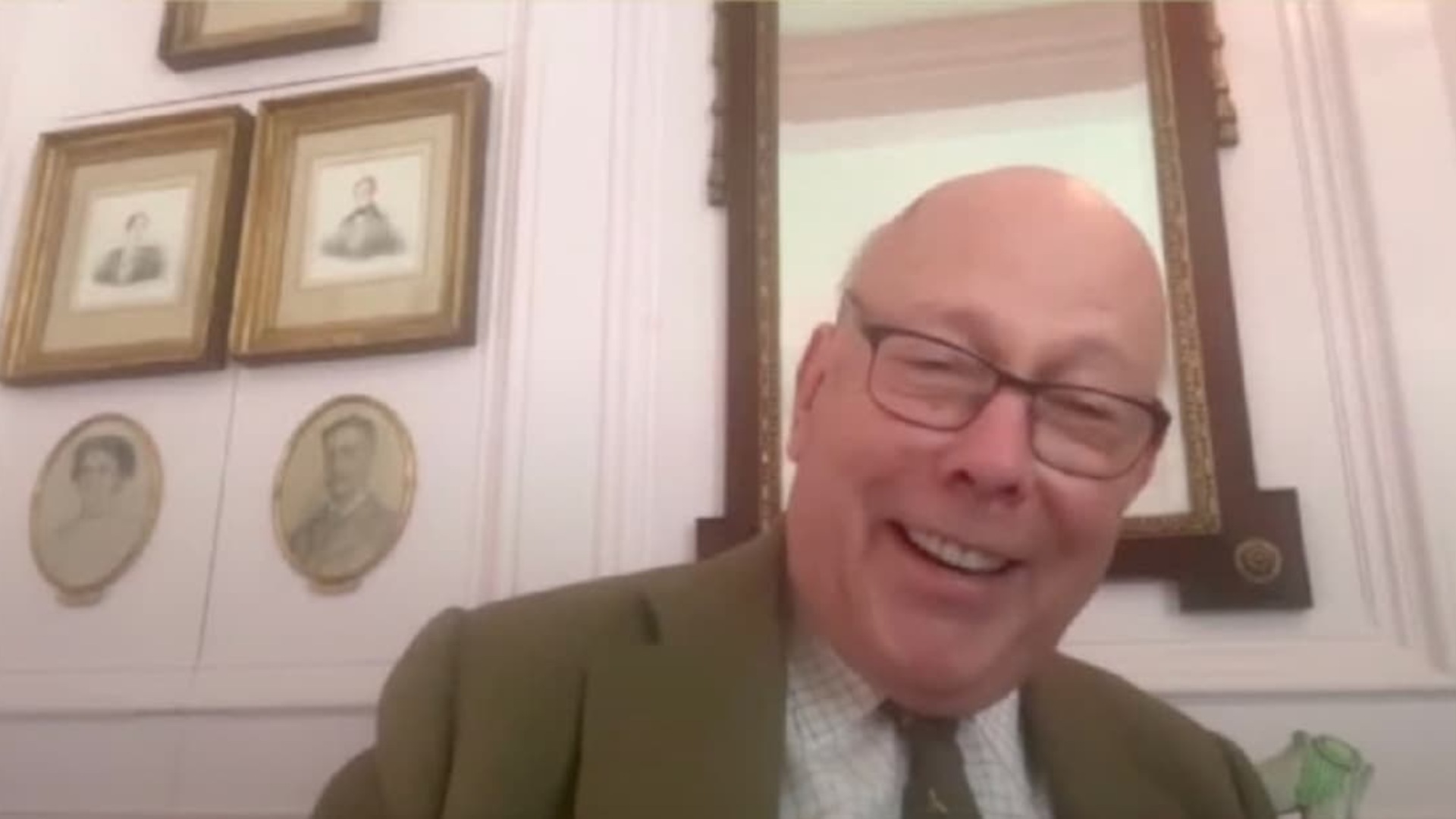
The creator of Downton Abbey, Julian Fellowes, discusses a range of topics with Imogen
Julian Fellowes wrote Gosford Park, created Downton Abbey and The Gilded Age, and spent twenty-five years as a jobbing actor before any of it — which he says is where he learned to write, by quietly improving mediocre scripts without letting the director notice. He talks to Yoreflix founder Imogen Cooper about why the industry does not much like period drama, why he gives both sides of an argument a defensible position, and the one thing that irritates him most in historical fiction: characters who think like us.
"They don't really support period drama"
Julian Fellowes: I'm getting into quite a complicated area, because the industry as a whole, certainly in England, is moderately left-wing. They all think they're much more left-wing than they are when it comes down to getting a decent restaurant table. But nevertheless, they are.
And so they don't really support period drama. They don't really like it. They don't give awards to it. They don't praise it. And its success, to some of them, is really irritating.
Imogen Cooper: Series like Wolf Hall have had to be fully produced before they'd land anywhere, which is part of why niche genre platforms are disrupting the market.
JF: Wolf Hall was very much its own type — almost a genre by itself. Quite deliberately, so I'm told, Hilary Mantel, who is very much a darling of that group, took history and stood it on its head. She gave Thomas Cromwell and Wolsey and all of these people personalities that were essentially the opposite of the ones they actually had. So there was a complicated and sophisticated intellectual game going on beneath the surface of those shows, which I found very interesting. I'm not saying that negatively — I think they were a very interesting piece of work.
But clearly, the kind of period drama where in the end everyone is happy ever after is not the same thing at all. I suppose I believe that if you have induced an audience to get interested in a group of characters you've created, and they stick with them for a few years, they deserve to see them happily settled at the end. Rather than leaving them on the rack.
Why the period, and why the women
JF: I find period drama interesting, and one of the main reasons is that women in different periods had a rather more difficult time. I know I'll be attacked for saying it that way.
There have always been intelligent and ambitious women, just as there have always been birds and trees. But they had to get round obstacles if they wanted their lives to add up to anything. If they wanted things done it was much more difficult, much more complicated. They had to be diplomats. They had to be tough in different ways. They had to argue and flirt and do anything to get the damn door open. And I find that interesting to write.
You don't really have that now. If you have a female character who wants to be a lawyer or go into politics, you just write it. Why not? But you're writing in 1850 — that's quite different. And in a way that puts a tension into the drama that is interesting.
IC: If you could go back to any period, as yourself or as a historical figure, what would it be?
JF: Probably a mid-Victorian. For the privileged, of course — life is always better if you're among the lucky ones, and that's no different now.
Given that, in the mid-Victorian age life was beginning to be comfortable. Medicine was beginning to be helpful, as opposed to largely unhelpful. Different elements of society were developing this extraordinary industrial energy, creating new people, new families, whole new cities in the Midlands and the North. The country was changing. All of that I find interesting and exciting — to write about. Whether I'd have found it exciting while living there, with nothing they could do about my toothache, is another matter.
The Victorians believed in the morality of their empire much more than the Georgians did. For the Georgians it was a question of making money: you took this here and sold it high, bought that low and took it there. It wasn't a complicated destiny or challenge.
That wasn't so for the Victorians. They thought they were spreading a moral way of life. Free trade was the great song of the Victorians — they were against more or less every other major power in Europe in proclaiming it. And they saw it as the work of God. It wasn't just people making money, it was people making the world a better place by being more open and less greedy.
Our present generation would retell a lot of that with a very different moral take, and I think they're entitled to. I'm not criticising them for it. The only thing I would say is: beware judging earlier periods by our own moral code, because what it actually does is create a barrier to understanding them. On the whole, what is interesting about history is learning to understand people with very different beliefs from your own. So I'd advise against being too hard and fast when judging someone in 1623.
"I'll be the judge of that, thank you very much"
JF: Drama — life, really — is the business of overcoming problems, and then you die. Period drama is much the same, except you don't have to die at the end of it. You can create endings that leave everyone with a slightly better taste in their mouth. I like to do that. Not everyone does.
What I always try to do, in pretty well anything I write, is make the disagreements reasonable on both sides. I get rather irritated with films that keep telling me who's in the right. You've got to sympathise with her, she's the one you're on the side of. And I always want to say: I'll be the judge of that, thank you very much.
I like to give the two characters a reasonable position. Neither of them is mad, neither of them is cruel. They both have a position that is defensible, and it's up to the audience to decide who they want to go with.
Sometimes you can make an audience change their mind, and that's very nice when you can do it. You have a character they've always disliked, and you give that character a storyline, and they have a different take. I hope we did that in Downton.
We had Thomas as the gay character — because of course the proportion of who was gay and who was straight was no different then than it is now. It's a question of how you dealt with it, and how you lived your life. I'd like to think Thomas was useful in making a couple of Colonel Blimps living in Northumberland just slightly think twice about their own prejudices. I don't ask for great conversions in Trafalgar Square. Just if you can make people question what they've always thought they thought.
Writing for actors you have already seen
IC: Is there a difference between creating your own characters and adapting existing ones?
JF: It's a different thing. When you're adapting a novel it already exists, it already has a form, and usually it already has an audience — which is why they want to make it. So it has a viability and a believability. Particularly when you're near the beginning and less experienced, it's easier to convince a producer this is a real thing, because it's already been a popular book.
Set against that: writing a series is the only time you're writing for a performance that already exists, that you've already seen. When you're writing series three, you know Carson, you know Mary, you know all these people. And by then you also know what the actors are good at. She can make you cry very easily. He's very funny. And you try to give them opportunities to demonstrate what they're very good at. That's conscious, for me.
So in that way I feel I'm making the characters with the actors — not usually in their way, which is to come in and present you with a plot, which on the whole you don't use. What they're giving you in their performances is the inspiration for what you give them to act in the next series.
IC: A film is different — you've only got two hours.
JF: A film doesn't really allow the actors much influence, because you've already written it before it was cast. It's only a series that lets you take what they're giving you and fashion it into what you're giving back. Though sometimes in films people are much better than what you wrote, and improve on it tremendously, and you're very grateful.
Twenty-five years of mediocre scripts
JF: I was an actor for twenty-five years. By the end I'd had some moderate success — a running character in a series, that kind of thing — but for most of it I was a reasonably busy jobbing actor, and I had to make the best of some scripts which, well, terrible is a harsh word, but they certainly weren't up to much.
You had to fashion them into something worth playing, without letting the director notice you'd changed the script. That was my training. I never did a course, never read a book about how to write a script. But acting in mediocre scripts in television series shown on a Thursday afternoon is a pretty good training, I can tell you.
IC: Do you ever want to get involved now, if an actor plays something differently from how you'd have done it?
JF: I have a slightly different situation now, because I've done reasonably well as a writer and had quite a lot made, so I'm usually a producer as well. That gives me a different hat, and I can interfere in other ways — with casting, and so on. But you have to moderate it.
As part of the recent writers' strike in Hollywood, one of their demands was that they should be on set whenever they wanted. I didn't really support that, because having the writer on set can slightly confuse the chain of command. There comes a point when the writer's original intention is less important than the director's immediate intention.
Finding your allies
JF: When I start something new, I look at the twenty people who tell me they're the producer, and I try to find one or two who are sympathetic to the show I want to make. So there are a couple of producers in the office who want to make the same show. Because the others don't. They want to make a different show.
IC: When you've created something like Downton Abbey, I'd hope people take your opinion seriously.
JF: They probably listen, if I'm firm enough. But you mustn't overuse that. It's like a marriage — don't go to the stake for everything. Pick the big fights, and let a lot of it go by. Quite often the director has a different idea about something, and it doesn't mean it's a worse idea. Sometimes it's a better idea. You have to ration the things you insist on. I think that's true of being a member of any working community.
In England, when you make a show like that — we had a very nice group at ITV looking after us, very supportive, and their ideas were always worth listening to. We didn't always act on them, but they were always worth listening to. In that way, the more successful it got, the more relaxed it got.
America is quite different, because the more successful it gets, the more people want to be part of it. You start off talking to about five people, and by series four you're talking to about eighty-five. That needs a different kind of diplomacy. Again, the key is to find your allies and uncover them wherever they may be hiding.
I rather enjoy all that. It doesn't drive me mad. And if the show turns out well and finds its audience, it's very satisfactory. It's a good way of life.
How accurate does it have to be?
IC: This is a question from our audience, and it's the controversial one. How accurate does historical drama need to be?
JF: Any kind of show — an opera, a ballet, whatever — has its own reality, and defines its own real world. Within the confines of that world, in opera where everyone is singing all the time, as long as they are true to their own reality, it's satisfactory. You don't say, this is ridiculous, she stopped singing five minutes ago and here she goes again.
A show like Bridgerton is of course not accurate about what was really going on. But I don't think that makes it invalid, because Bridgerton is showing us a new kind of period drama. They're sticking to their own logic and their own truth narrative, and they aren't saying this is how it really was. They're saying: this is Bridgerton. That seems to me fine.
What is rather irritating is shows that suggest they are telling you the truth, and then don't. I'd make an exception of Mantel, because the fact that she was telling the opposite of the truth about Cromwell was somehow part of the art of what she was doing.
I mean an ordinary account where you can see that the sympathies of the maker are so strongly represented that the other side is completely unrepresented. That's not only irritating but rather unrewarding, because it can be quite bewildering to watch — they're not giving you the other half of the argument at all.
Characters who think like us
JF: Another thing that annoys me is when they insist that the lead — usually the juvenile lead, but anyone — has completely modern attitudes to a particular situation, because they think that's more sympathetic to a younger audience. And you're up against that quite often as a writer.
For me this is completely flawed. You can have people with ideas ahead of their time — they've always existed, in every period, and that's all fine. But what you can't have is completely modern assessments of situations that just wouldn't have happened. They wouldn't have thought that way.
Part of the fun is getting your point through without making the characters come out of their own period — by allowing them to stay within the reality of their own time. Mary, in Downton Abbey, could explore something like contraception, which was very modern then but did exist. And she does explore it. But she doesn't go into the shop and get it herself and show it to her mother. The whole thing is conducted in a completely 1920s way. I think that's fair enough.
So I don't find it limiting. I find it quite interesting. With politics and other things, there were people whose views were really more akin to the forties and fifties than the twenties — but they existed. Those people really existed. That has to be one's limit.
"Tell that to the Marines"
IC: My personal pet peeve is contemporary language in something set very long ago. You'll be watching something set in the 1400s or 1500s and someone uses a phrasing that's completely contemporary, and it throws you right out.
JF: Particularly nowadays, when it's so much easier to get the original data on the use of a phrase.
The only thing I'd say is that I'm not very good at what I call period speak, where people deliberately use incredibly long formal words about everything. Instead of let me see that, they say let me contemplate that. And you think — come on. Nobody talks like that.
The other thing is that many phrases are much older than we realise. I always remember reading the Trollope novel The Eustace Diamonds. There's a moment when a character is talking to Lizzie Eustace, telling her about the fences, and she says: tell that to the Marines. If you read that you'd think it must be a Second World War phrase. It was the 1860s.
Personally I like to use those phrases. I check them. I make sure they were in use. I don't like to place a fence around the characters with the language — I like to make them accessible, but within the discipline of only using words and phrases that were in fact in use, even if people don't know it.
IC: One of my favourite facts, from a book I read about Shakespeare, is that only 5% of the language he used is not still in common usage. He just used it in clever ways that made sense linguistically at the time, and now the structure doesn't — but 95% of the actual words are still current.
JF: Very interesting.
What's coming
IC: Anything you're working on that people will be pleased about?
JF: They'll be pleased to hear there's a new series of The Gilded Age on the way, and I'm very pleased with it — I think it's turned out very well. One of the nice things about a long series is that the actors, if you've chosen well at the beginning, get better and better the longer you go on, and the more they get into the skin of their characters. I always enjoy that.
And there's another Downton film coming. Then I've got three or four other projects waiting for a green light, of which one or two will probably get it. And then we'll be off again.
IC: Thank you so much. It's been such a joy.
JF: I've enjoyed it. And I think your idea is marvellous. I'm looking forward to watching Timothy West in Edward the Seventh and various other things that haven't been seen for years. I don't care about the wobbly sets — that doesn't bother me any more than it bothers me on stage. But there is so much good material that we haven't been allowed to see for ages.
This interview has been edited for length and clarity.