
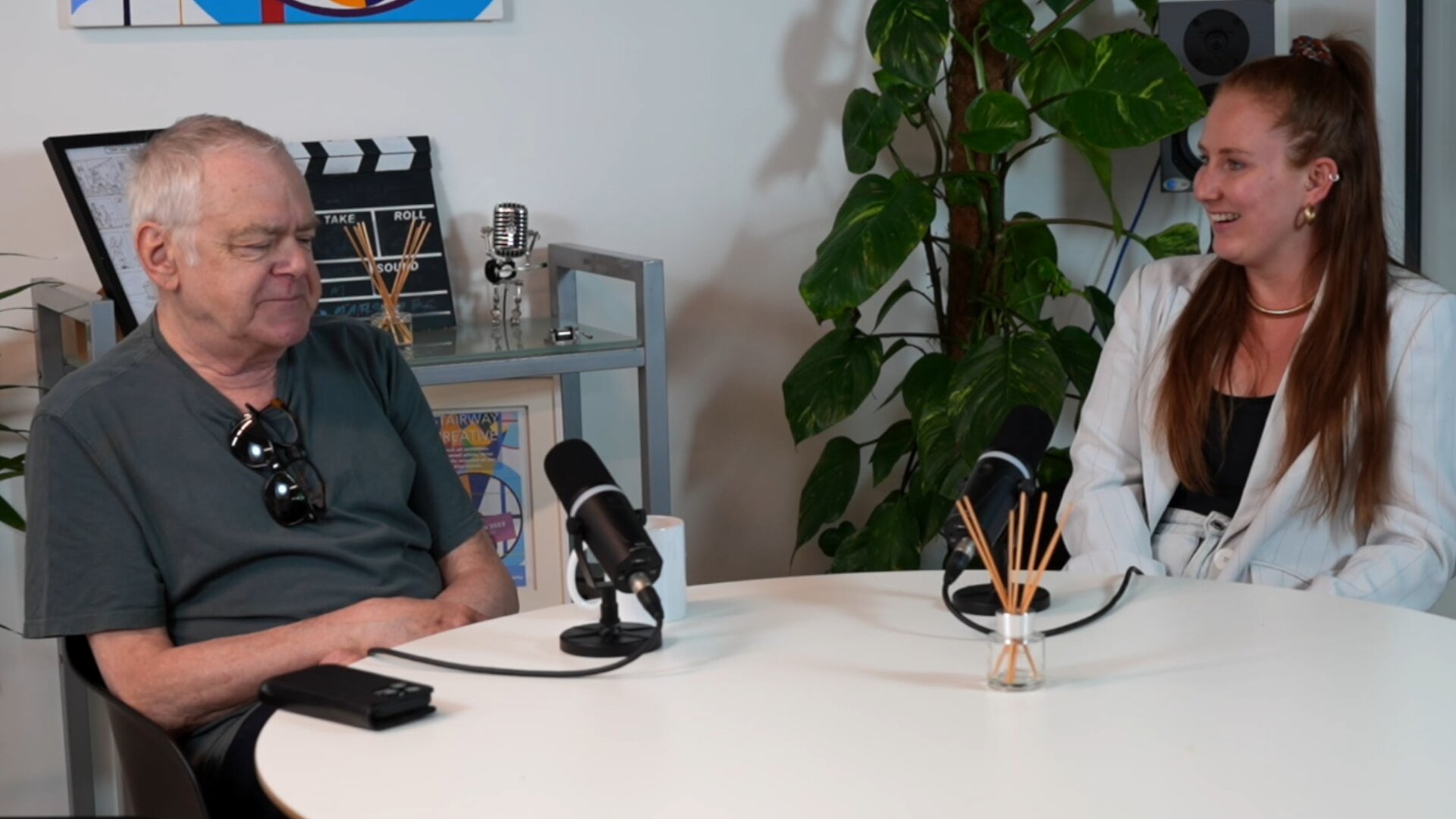
The prominant actor Kevin McNally chat's through his acting career
Kevin McNally has been Mr Gibbs in Pirates of the Caribbean for two decades, and before that was in I, Claudius, The Duchess of Duke Street and the original 1970s Poldark — "stuck in the past for a very long time". He owns a painting of himself on an oven glove. He talks to Yoreflix founder Imogen Cooper about why period dialogue should sound spoken rather than written, what a costume does to a performance, and why he would rather have dinner with three painters than three politicians.
Mr Gibbs, and an oven glove
Imogen Cooper: Pirates of the Caribbean — is that what you're best known for?
Kevin McNally: I think so, absolutely. I can always tell by doing comic cons — the percentage of pictures missing by the end of the weekend. It goes Pirates, Supernatural, Doctor Who.
IC: Only one of those is a period drama.
KM: True. Though I did another period drama in America called TURN: Washington's Spies, which is quite popular too.
IC: Do you enjoy the conventions?
KM: I love it. It's nice meeting people and chatting. And with Pirates it can be quite moving. I've had a couple of experiences where my assistant says there's somebody over there who wants to come over but is too shy, and they'll come and tell me some moving story about how they had a dreadful childhood and their go-to place for comfort was watching a pirate film. That makes you feel really good about it. It's a bit like payback.
Unless you're an insane egotist.
IC: Has anyone turned up with a tattoo of your face?
KM: Not of my face. A lot of pirate-related tattoos. But I do have this huge pile of paintings of me as Mr Gibbs. I have myself painted on a boot. I have myself painted on an oven glove. It's the weirdest collection of memorabilia you could ever wish to have. My study is getting rather full. I wouldn't mind it drawing to a halt.
IC: Is there a line people always ask for?
KM: About three. The big one is take what you can, give nothing back. But my favourite is slap me thrice and hand me to me mama, it's Jack.
Five months at sea, and three port-a-potties
IC: Was it fun?
KM: Think how much fun it looks and times it by two. It was hard work — very long hours, five months to shoot each of them, and a lot of it at sea. For me, having made a number of films but not massive budget ones, that was something.
I have to say it was more enjoyable at the beginning. We started the first film just before the Marvel franchise started, and in the old days, when we wanted to split a ship in half, we split a ship in half. Then we became increasingly green-screen reliant, which took a lot of the fun out of it as time went on.
IC: So you were genuinely at sea?
KM: For the first three, yes. It was great — apart from some very unsailorly stomachs on board, and about three port-a-potties. Hitting the odd wave and a port-a-potty going over, that was quite fun.
IC: Do any of the films hold a special place?
KM: I always say number two. First because we knew by then it was a successful franchise, and second because it's got the most Mr Gibbs in it. Which I think should make it everybody's favourite, don't you?
KM: The first three all premiered at Disneyland — there's a little circular lake with an island the steamboat goes round, and they built the biggest screen I've ever seen on that island. An amazing way to see them.
Funnily enough, when I started I didn't know anything about the history of it. I phoned my daughter and said, there's a lot about this that seems vaguely familiar. She'd had an operation a couple of years before which meant she couldn't fly, so I'd taken her to Disneyland Paris — and she said, we went on the ride three times.
IC: Does Pirates count as period drama?
KM: Probably not.
IC: You're in that camp? For a lot of people, the fact that it's set in a non-contemporary period means it counts.
KM: Well, there's a lot of period costume in it — particularly those wonderful dresses Keira wore.
IC: We'll allow it in for the day. Especially because you were Mr Gibbs.
"I don't want it to be literary"
IC: Miss Austen is properly period. Did you enjoy it?
KM: I loved it. The girls were fantastic. I only have one bugbear with it, and I have it a lot with period drama.
Anything pre-recording, we don't really know what they sounded like — so we tend to take their voices from the written literature. And even today, we don't condense in writing as much as we do when we speak. So it jars a bit when somebody says, I have told him that I will not be there on Sunday. No. They probably said, I told him I won't be there Sunday. Just like we do. Go back to Shakespeare and you can see he contracted sentences.
Next time I do one, I'm going to sit down with them and say: can we get them speaking like normal people, and not like they're speaking out of a book?
IC: I had a very similar conversation with Julian Fellowes. I'm something of a prescriptivist — if I'm watching period drama and someone uses language that feels really contemporary, it throws me out.
KM: I'm not saying they should all go around speaking contemporary. I'm as much of a pedant — try typing there, their or they're wrongly in an email to me and you'll get murdered.
IC: If I'd got that wrong in a text, would you not have shown up today?
KM: I would not have come. I'd simply have decided her intelligence isn't worthy of my presence.
IC: And I'd totally not have blamed you. I grew up in a family of pedants.
KM: My bugbear isn't really about it being contemporary. I just don't want it to be literary. I don't want to feel like I'm reading it, which is sometimes how I feel watching these things.
IC: I wonder if Miss Austen being primarily a US-commissioned show has something to do with it — because the US audience see Jane Austen land in a very specific way.
KM: Probably true. And because it's been like that for years, it's comfortable on people's ears. I still get a little stew about it.
What the costume does
KM: I'm all right with the costumes. I was talking to a costumier about this — even if you go back to the 1930s and look at pictures of people on beaches, or in Los Angeles, I'm amazed the men are all still in suits. Can you imagine wearing a suit in the height of a Los Angeles summer? It'd be insane. But they did, and they dressed very uncomfortably in Jane Austen's time too. We had a beach scene where we were all poshed up in high collars and hats and buckle shoes.
IC: Do you ever get tempted to go out into the world afterwards in costume, as a gang, and see what happens?
KM: No, I'd be arrested. It would be ridiculous walking around looking like that. As you can probably tell, I'm a very casual dresser — I've made no effort today whatsoever.
But there is a sense that the moment you don the costume, you don the character, and you keep it for that. Costume, character, accents — they all go together, and they're all part of the craft. I enjoy every element of that.
Stuck in the past
IC: Is there a period you haven't acted in that you'd want to?
KM: I've done lots of them. One of the first things I did was I, Claudius — Roman. Then The Duchess of Duke Street, set in the early 1900s. Then straight on to the first incarnation of Poldark, back in the seventies, which is of course the eighteenth century. So I was stuck in the past for a very long time, and I was very much looking forward to being somebody contemporary. But they pop up so regularly, because they're so popular.
I'd like to do a few more in future. Though I'm a bit of a science fiction nut.
IC: That would completely crush the boundaries of what counts as period drama.
Cosy crime, and why the platform exists
IC: The reason I'm launching Yoreflix is that historical and period drama has such a dedicated fan base, and there's nowhere to get it in one place without cherry-picking across platforms.
KM: The other big genre people love, especially in America, is what they call cosy crime — British procedural.
IC: Which is exactly one of my case studies, because Acorn and BritBox already exist for it. And there are niche platforms for horror, another genre with a really dedicated following. Because I'm a history nerd —
KM: Buff. We prefer the word buff.
IC: I'm a history buff. That's nice. Slightly more positive.
KM: Now that I think about it, a lot of Americans come up to me at conventions wanting something either from TURN or from Downton Abbey.
"It's like bring your husband to work"
IC: Did you enjoy Downton?
KM: Very much. My wife had been in it from the beginning, so I'd lived with it for ages.
There's a funny story. I phoned her and said, I've been offered a job. She said, what's the job? I said, Downton Abbey. She said, no, come on, what's the job? I said, it's Downton Abbey. And she said: oh God, that's so embarrassing. It's like bring your husband to work. I don't come spoiling Pirates of the Caribbean for you.
IC: How did that make you feel?
KM: It made me laugh.
I came in at series three, when it was already a huge show. And because of the misbehaviour of the child I was trying to get — he was so badly behaved — my second two episodes were moved to the start of series four. So I got extra episodes out of it. Next time I do anything with children I'm giving them sweets and hoping they really freak out, so I get more work.
IC: Ply them with sugar and see what happens.
KM: There was also a television version I did in the early eighties, just before Diana, of Maria Marten, or The Murder in the Red Barn, which is a lovely story. Then there was a bit of a lull — a few wartime films, both Nazi-based. Really, it was doing Miss Austen that felt like the first time I'd got into that thing again. A nice revisit to the genre.
Where is the cut-off?
KM: My take on history is that I like the different perspectives of different cultures. But if we go past 1950, does it still count as historical costume drama?
IC: I get asked this constantly, and it's controversial. I say anything up until the 1990s.
KM: Blimey. So what you're saying is, I've actually lived in costume drama.
IC: You have indeed.
KM: Brilliant. So flares count.
IC: I do have a caveat, which is that the more contemporary you get, the more stylised it has to be. If you go back to the eleven or twelve hundreds you don't have to try very hard. If you're doing something in flares —
KM: Make the collars extra big.
IC: Really beef up the shoulder pads. Make it obvious you're doing it in a stylised way.
KM: I want to do something in the seventies now. And the cars were great.
IC: If you could go back to a period yourself, not as an actor, where would it be?
KM: The early seventies. It was a very interesting time for me — I was starting to grow up rather than be a child, and I had my first job in theatre, drama school, and Led Zeppelin, The Who and Pink Floyd. That's all I needed, really. And the odd dodgy cigarette.
But I'd love to go back and see it and think, no, I don't remember this aspect of it at all. That would be really interesting.
IC: I'd go back to England in the 1100s. Robin Hood time. I always wanted to be Maid Marian.
KM: I'm not sure that as a woman you'd have a particularly good time back then.
IC: Probably not. There's also a period I really want to make into a drama — the 800s, in what is now Western Europe, not the UK. It's what I specialised in at university, and it has everything.
KM: Does it have old blokes in it?
IC: I would assume so.
KM: Then go ahead, that's absolutely fine. I'd be some old wise Viking. Or a Pict — I'd like to be a Pict.
Accents, and where you speak from
KM: I'm particularly interested in the development of American English. When I was filming in Virginia there's a place which was one of the first they landed at from Cornwall — and they do speak Cornish. A remarkable little historical thing.
And John Barton, the great Shakespeare expert at the Royal Shakespeare Company, researched a lot about how people would actually have spoken in Shakespeare. There are ways of working it out by looking at rhymes, to see how that affects pronunciation. He was pretty sure most Elizabethans spoke with something closer to an American accent, and that it was imported over there. Then over time — probably through class, and through a lot of our royalty coming from Germany or France — our English changed and became slightly more Germanic. That vague country hard R survived over there, because they didn't have the same class system.
IC: Do you have a favourite accent to do?
KM: I always promised myself that when I went to America I'd only play Americans — because with an English accent you either play Romans or Nazis, and I didn't want that for the rest of my life.
Early in my career, doing new American plays, I'd do New York, as a punk kid, or California. But a man said to me: you've got to learn a Midwest accent, because apart from in the South, the majority of people speak with a Midwestern accent. And he's sort of right. I realised it listening to Jack Nicholson, who was born in New Jersey but sounds Midwestern every time he opens his mouth.
IC: I'm so impressed by anyone who can switch. My younger sister is an actor and she's amazing at it — one of her favourite games at Christmas, once I've had a couple of red wines, is challenging me to do the accents she's doing, knowing full well I can't resist a challenge and I'm awful at it.
KM: I tell my students they should really try it. Some people have the skill and some don't. I find most people who are good at accents are usually very musical, for fairly obvious reasons — somebody a bit tone deaf isn't going to pick up the rhythms and pitches of other people.
IC: Now I'm thinking I should be better at accents, because I'm a musician. I play multiple instruments.
KM: Then you'd be a prime candidate for me. My classes are very cheap.
IC: I know there's a whole thing about where your tongue is.
KM: There are many things. One of the technical things actors need to learn is the places in your body you speak from. You can speak from your diaphragm, from your chest, from your throat, or in your head — and different ones lend themselves to different accents.
I'm also a ventriloquist. I'll bring the vent act along next time.
Three painters
IC: If you could have dinner with three to five historical figures, who?
KM: I've never been asked that. I would not like them to be political figures. I have a feeling it might be Van Gogh, Picasso and Monet.
I'd be much more interested at dinner in what they had to say than in what Mussolini, Hitler and Churchill might have to inform me of. I'd choose painters — I can sing and play the piano a little, but when I travel my first port of call is always the galleries and museums.
And I wouldn't want a table full of actors, because acting has changed so much in the last century. I don't know how people acted on stage in the nineteenth century, but it would probably be anathema to us now, with the gesturing and the shouting and the showing off.
IC: Would there be any intrigue in someone who'd acted at the Globe?
KM: That might be interesting — the craft at the time, and the politics of theatre, because we don't really know very much about it. I played King Lear at the Globe about seven years ago, did a bit of research, and was amazed how little is known.
IC: One of my favourite random facts is that only 5% of the words in Shakespeare's plays are not still in common use.
KM: That's right. My theory is to cut them all. Actually you've got to cut Shakespeare anyway — I don't think they were ever performed at full length. There were versions, and people added things. So you try to find the essence of it.
It is difficult to go back, though. I was reading the other day that we only really have three thousand years of recorded history — which is relevant to historical drama, and you wanted to go back to 1100, or 800, for God's sake. That means there's a quarter of a million years of human history we'll never know anything about.
IC: Absolutely.
KM: I don't think a lot went on, to tell you the truth. I think there was a lot of digging and eating.
IC: Digging and eating and chopping. So the dinner party is very much painters.
KM: They'll be lovely. Though Picasso might be a bit tricky, and Van Gogh's a bit quiet.
IC: I wonder whether they'd get on or all clash.
KM: I don't think they'd like each other's paintings, that's for sure.
This interview has been edited for length and clarity.