
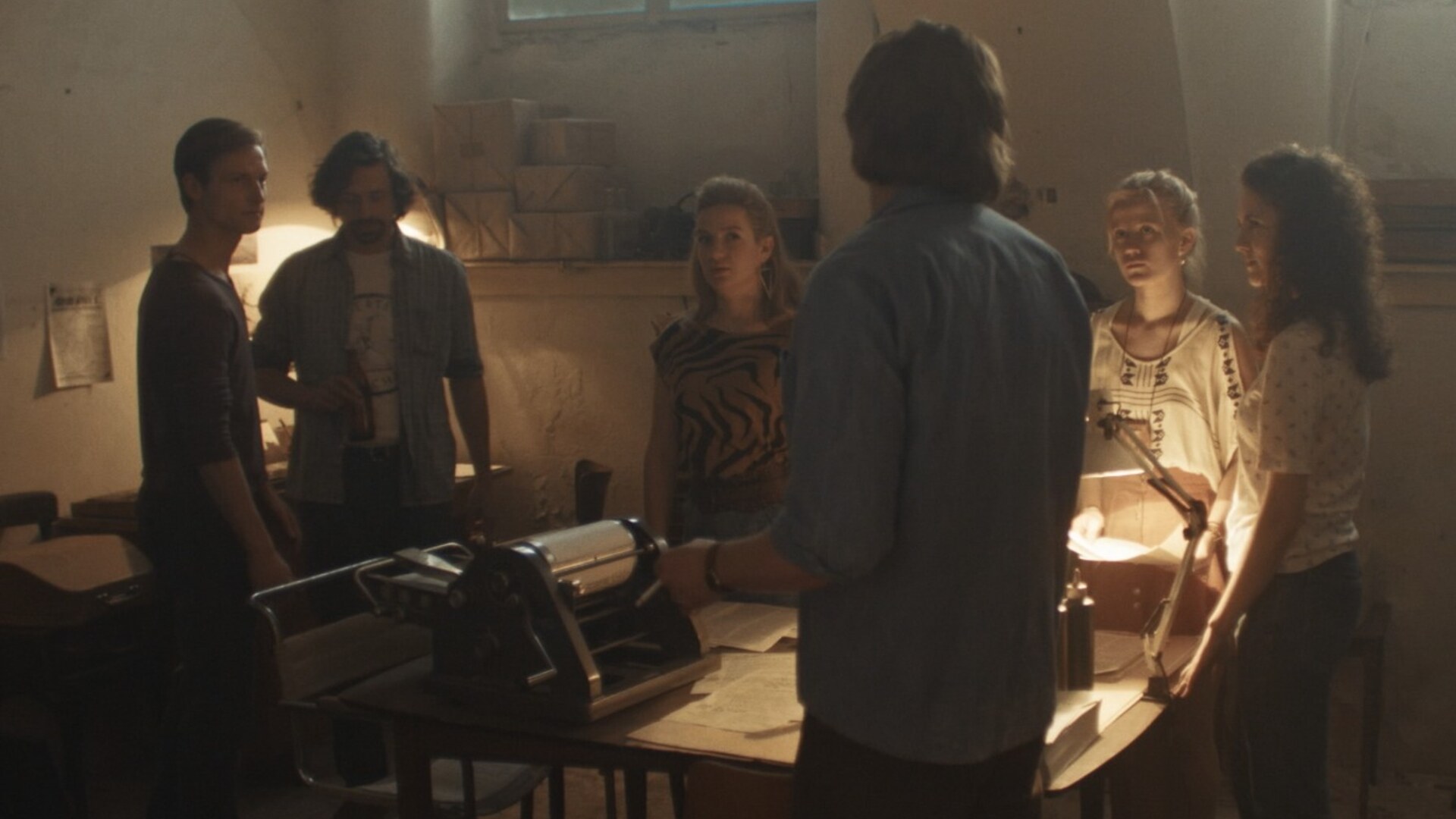
In a collapsing East Germany, two devoted sisters face painful ideological rifts and long buried family wounds, forcing them to confront what love and loyalty truly demand.
This page opens with the synopsis supplied by the programme’s makers. Everything after it is our own.
Germany 1987. Two sisters and their grown-up children find themselves on different sides of the political fence in a rapidly disintegrating East Germany. Margot is a major in the state security service (Stasi), Lotte is in the opposition.
We meet the women in the chaotic years between 1987-1990 as they fight for their ideals. A third sister, believed drowned years before, turns up in the West with a secret to tell on the eve of the fall of the Wall.
A poignant look at the Berlin Wall's fall and its aftermath.
It opens with a man admitting he may not remember it correctly. "I'm not sure if I remember every detail correctly. But who does?" Then a caption: Ministry for Foreign Trade, Commercial Coordination Department. Then a quiet evening in which, from the outside, nothing at all appears to be happening.
Beginning a story about the fall of the Berlin Wall that way tells you what kind of series this is. The Wall spends very little time on the night the crossings opened. Its subject is the machinery underneath: the department that earned the GDR its hard currency, the accounts in Switzerland, the sixty billion marks, the people who understood what the numbers meant before anyone else did.
The story follows two sisters on opposite sides of the argument, and the series is careful not to let either of them stand for a position. One believes in the state she was raised in. The other has stopped believing. Neither is naive, and neither is straightforwardly right, because what was collapsing around them was more than a political system. It was a set of promises about how people should live, made to a generation who took them seriously.
What the series captures particularly well is the texture of the last years. A woman who has been waiting for her coal delivery since November is told, without apology, that the man delivering it is not Santa Claus. A bicycle is taken. There is a bookshop, and an instruction to write a report, and the question of against whom. "Against the unknown." None of the absurdity is played for comedy, because that is simply how the days went.
The commercial coordination office, where much of the drama sits, was real: a department created to acquire Western currency by any means available, operating under rules its own staff describe here as strict. No exchange of information between authorities. Absolute confidentiality. Watching people learn those rules, and then watching the system that made them dissolve, is the spine of the thing.
German-language drama has returned to the GDR repeatedly, and the strongest of it shares this refusal to treat the East as a curiosity. The people here are living in a country rather than a museum exhibit, with jobs and rivalries and family obligations, and the ground is about to move.
Directed by Michael Krummenacher. In German with subtitles. Set in 1987, in the last stretch before everything changed.