
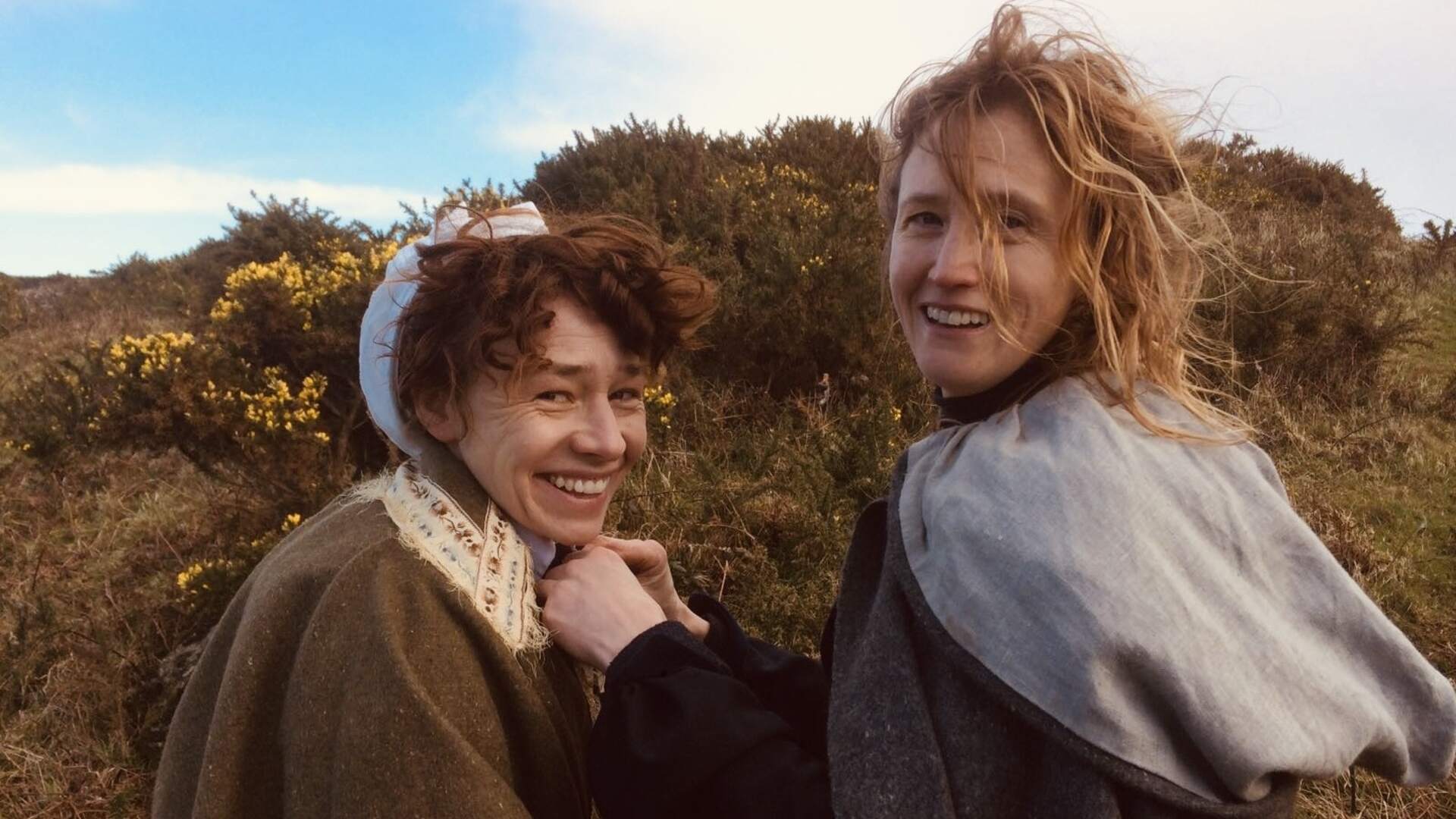
Writer, director, producer and actor Caroline takes us on her film creation journey
Shalborne is a feature film set in Devon in 1905, about a woman with no voice, a dependent father and a letter that changes everything. Caroline Corrie wrote it, produced it, directed it, sewed the costumes on her kitchen table at two in the morning, cooked for the cast, and played the lead. It took seven years, a crew of four, and under half a million pounds — and she has not been paid for nine years. She talks to Yoreflix founder Imogen Cooper about RADA, the missing middle of the industry, and why the best art comes out of restriction.
Ballet, RADA, and graduating at thirty
Imogen Cooper: Start as far back as you like.
Caroline Corrie: I started in acting, and before that ballet — I wanted to be on the stage from the age of four. Absolutely passionate, no question at all that that was what I wanted. So I went through all the channels I felt I should. A degree in drama, then RADA, training as an actress for three years. I got an agent. I did all those things.
And then realised: oh, this is really difficult. I graduated when I was nearly thirty, so I was coming out as an older woman — not the young ingenue — and there aren't many parts for thirty-year- old women. I was also married, and shortly after graduating had children. Various challenges there for a career woman, especially in acting.
So when my third child was two, I thought I needed to take charge of things myself and fit them around my life. And the only way to do that is to make your own work. I wasn't in any way keen to give up the career I'd worked all my life for.
So I wrote a screenplay.
IC: When was this?
CC: 2016. I'd never written a screenplay before, but I'd run a theatre company where we wrote plays collaboratively, and I'd done playwriting as part of my degree, so I knew how to structure a story.
A woman on Dartmoor, in 1905
CC: We'd studied nineteenth-century women at university, which I found fascinating — particularly Ibsen and Shaw, and how they represented women on stage. All that conversation about women as a commodity, women as trade, was a big theme around the turn of the century. And being a mother, and unable to work because of my responsibilities, I was thinking: how much has really changed for women in our time?
Lots has changed. But it wasn't difficult to span the twentieth century back to before female emancipation and find a woman I identified with. I'd also thought, I really want to make a film for every decade of the twentieth century with a woman at the centre, to explore that arc.
IC: I must have read A Doll's House about ten thousand times at A-level. It's so interesting, the parallels between the literature of the time and what still happens in a lot of women's day-to-day lives.
CC: And it was largely male voices driving that conversation. Ibsen is a male writer — but there were all these brilliant intellectual women contributing, very much in the background. Once you start peeling back the layers and realise whose voices were being heard, and the effect they were having.
My protagonist, Helen, lives in rural Devon and has no voice. She doesn't have children, because I didn't want it to be about anything other than her — but she does have a dependent, an elderly father.
I started from: I need someone I can play, because I was principally making it to create a role for myself. So, early forties, middle class. Where could I film it? I was living in France but had connections to Devon, and there are so many beautiful timeless landscapes there. So in my head I put this woman on Dartmoor. And then I thought — why is she on Dartmoor? What is she doing? Is she with anyone? Is she escaping something? And it unravelled from there.
Why 1905
IC: If you could go back to any period, is there another you'd like to delve into?
CC: Every period I go into, I think, there are so many stories. Right now I'm researching 1977, because that's the setting for my next film.
What I love about 1905 is that everything is pre-machines, pre-cars, before the industrial revolution on a massive scale — though the rumblings were starting. I love the simplicity of the clothes, the lifestyle. Making Shalborne, just boiling water on a twig fire with a copper kettle — everything was made to last, and it all works. Nobody had over-thought it. I'd happily give up washing machines and cars to go back to nature a bit and be resourceful with what you have.
IC: Set the scene for us.
CC: Women haven't got the vote yet, and it's quite a way off. Queen Victoria died in 1901 — and it struck me the other day, when I think back to 2000 that seems like yesterday, and that's twenty-five years. Put time in that perspective and think what happened in those early years of the 1900s. So much changed so quickly. To lose such an imposing monarch. Then Bloody Sunday in Russia, which for me was really significant, because it triggered the revolution. Then the assassination of Franz Ferdinand, and suddenly the First World War. That is not a long time frame in which to find the world fully in a gruesome war where everyone is implicated.
And it struck me how relevant it is. This was before Putin invaded Ukraine that I was writing it, and I was looking at Russia and the Russian Empire, and the fragility of that whole network in Europe, and how it was impacting personal lives.
IC: Fragility is a good word. The nature of humanity is to be fragile, and learning from the past to make things less fragile doesn't happen as much as it should.
CC: Hopefully it triggers curiosity. It was studying the period to write the screenplay that made me learn so much more about Russian history. And then you understand — you can't justify Putin's actions, but you understand what motivates the desire to recreate the Russian Empire, to put it back on the map, because they feel like the poor abused little brother of Europe. Unless you understand that, you can't really have an intelligent perspective on what's happening now.
Italian wool off eBay, at two in the morning
IC: Tell me how it came together practically.
CC: In tiny little pieces. Each step was: let's just get through the next one.
Once I'd written it, the next thing was costumes. I looked into hiring, just to do a little pilot that would give a taste of what it could be — and any hire was a minimum of £150 for a top and a skirt for the week, plus insurance, plus delivery. I thought, this is not going to happen. So quite early on I decided I'd make the costumes, because then I'm in control of it. I'd done some sewing at university as part of stagecraft — I did wardrobe.
So I made the first travelling suit my character wears, out of beautiful Italian wool I bought off eBay for about £40 — rolls and rolls of it — cutting it on the kitchen table.
IC: There's producing, and then there's producing. You're at the kitchen table with Italian wool.
CC: At two o'clock in the morning, often, because I had three very young children. There was no way it was happening in the day.
IC: Did you sleep?
CC: I was used to it, having been up with little children. And on the filming days I fed everyone as well, and put the actors up, and did all the props and the producing. When they came down from London I cooked them a meal and we all chatted and had beers — it had to be fun for them. Then after they'd gone to bed I'd think, right, now I need to make sure I've got all the props. So there were some very short nights.
A crew of four, over seven years
CC: Once I had the costumes, I shot a few short clips with a friend who had a DSLR — not a great camera. I took that to Simon Niblett, who's the DOP on the film. He's Emmy-nominated and lived near me in Devon. Simon came on board, and then I could look for actors — and each one who joined would say, have you spoken to so-and-so? It rolled like that.
Four years to film it, about two years to get it into production. The whole thing was seven years.
IC: How did you find the actors?
CC: Through my own network. The first was Peter, who plays my father — I'd worked with him on a play and we'd kept in touch. He's an amazingly experienced actor. The rest were essentially RADA graduates.
There are so many brilliant actors not working, it's insane. The industry does them such a disservice, and is foolish not to tap into this enormous pool of brilliantly trained professional experience. Actors can be jobbing actors their whole lives, with so much experience, and never once get to play a role with an actual character arc. That's what I felt — that I deserved better. And that's why I made it happen.
Now I've gone into production and can see how the industry casts and finances, it's almost laughable to think of the hours you spend at home as an actor thinking, maybe my agent will call today. You're a million miles from that job. Even the casting directors have to fight. I got a job once and was then taken off it because I wasn't important enough, and the casting director had really fallen for me. And other times — Nina Gold, an amazing casting director, fought for me and fought for me, and I did get to do it.
IC: How did you manage locations, crew, all of it?
CC: The crew was Simon on camera, Dave occasionally on sound, and me and my husband on tea and every other logistical thing. That was the crew.
And I think that is a totally acceptable crew for a feature, if everyone is really on it, which we were. Simon is so good with a camera, he knows his lenses so well, that the magic is created there. As long as I could facilitate the actors being there and make the thing look beautiful — the set dressing, all of that — it is possible with a few very focused individuals.
IC: One of my least favourite misconceptions is that period drama has to be crazy expensive, and that there's therefore no place for it.
CC: The more crew you have, the more people you need to look after the crew, and the more trailers, and the more people to feed. As much as I wouldn't want to put talented crew members out of work, there is good in being focused with your creativity.
The missing middle
IC: There's a series of binary mechanisms in the industry right now, and it's left a middle ground that's getting sparser — nothing being cultivated, nothing being made. At the top you have enormous budgets and the gatekeeping that comes with wanting top talent all the time. At the bottom, budgets that will never make anything anyone sees, because getting to £600,000 or a million is so hard. That middle ground not being cultivated makes me quite angry, very uncharacteristically.
CC: A friend of mine produced a very high-budget streaming series where at one point they had three thousand people in the crew, and the director and the first AD had four or five assistants each. He'd step away from set and think, I couldn't manage this many people if I tried. About half of them are doing nothing, and I can't do anything about it, because someone has had money thrown at them and everyone's accepting it.
IC: Are you happy to say what the budget was?
CC: Under half a million. It's hard to quantify, because people gave so much time. The actors weren't paid — I paid their expenses. A lot of people weren't paid anything. I haven't been paid anything in nine years.
The only reason I could do it was that I didn't sleep.
IC: And you paid with your time and your sanity.
CC: My husband is a builder, and we've built and developed houses and lived in them, which is a complicated life — I've cooked on a camping stove for most of my private life because we haven't got a kitchen, because we're building it. We've concluded that filmmaking is similar to property development: you want to create this incredible, beautiful thing and you have no money to do it, so you find beautiful things, or craft them, and stay up all night.
IC: That's almost romantic.
CC: That's art. The best art comes out of being restricted, not out of having a million people standing around saying, when do you want me, I'm here if you need me. It's too indulgent. Too comfortable.
And I don't think a smaller crew means people end up out of work. If you could fund that mid-budget range — just make more. Be creating all the time. It doesn't have to be award-winning; just do your best to learn the craft. That's what most people are looking for. Artists like to create.
Poirot, Burgh Island, and Sense and Sensibility
IC: Do you have a favourite period drama, apart from your own?
CC: There are a million. I'll start with Poirot — I could watch it all day long, day and night. I can see Burgh Island Hotel from my house. And I love Miss Marple, all of them. I decided at about sixteen that I just wanted to live in an Agatha Christie novel.
But Sense and Sensibility really touched me when it came out. I thought it was the most brilliantly made thing. We have traditionally created the most brilliantly written, beautifully crafted films — that's what we do so well. And the idea that there could be pressure from on high to compromise all of that, because it needs to be this way or that way. I feel really strongly that we have so much talent in this country to make the most fabulous work.
IC: If you looked at the budget for Sense and Sensibility it's almost laughable next to what gets spent now. And it's beautiful in every way — the acting, the script, the atmosphere, the colour. Simple, in so many ways. I'd hazard that there's more chance of ten more adaptations of it being made than of anything original, or any IP that hasn't been picked up before.
CC: That's a shame in itself. It's standalone. It's a lovely film. We don't need ten more of them. Let's do other things.
The pre-sale, and what happens after you finish
IC: Did you try to get a commission, or a pre-sale?
CC: At all points along the way I tried to get funding. I applied to the BFI. I went down every single route, tried to get producers on board, did everything possible. That's why it came in tiny steps — at each one you think, I now have this much material, perhaps someone will come on board, perhaps I could pre-sell. And when that didn't happen, I wasn't prepared to say, we'll stop now. Each time we had more material, in order to give value to that material, we had to keep going.
There were so many times when I thought, I may never finish this, and then all that work is for nothing. Even at the end, when you've finished principal photography and you've got your final cut, it has to be graded, and there's the sound, and the music — the music took a year, it's an entirely original soundtrack.
When you think you're finished, you're definitely not finished. Then there's the sales, the distribution, the festival submissions, which are really expensive.
IC: You went for a theatrical release.
CC: Yes. And having come through it all, and learned so much more about funding, I'm not convinced by the pre-sale scenario. What would be really wonderful is if rich people could just give their money freely and trust the artist to deliver.
IC: Pre-sales come with a strict element of creative control. I've been on the side of having to enforce that, to appease commercial partners, and it always felt pretty icky.
CC: With a pre-sale you've almost surrendered the project before you've started it. You're making it for someone else. You've already managed that loss.
I've become quite protective of the film, because I think it's beautiful and has massive value, and I'm nervous of pushing it into the wrong channels. Shalborne will have such a loyal audience that I don't want to put it on the wrong platform and find it lost in a back catalogue, or in algorithms that aren't favouring it.
IC: The more I understand about how everything is financed, and why, the more it makes me want to do the exact opposite.
CC: You have to stick with the soul. If there's no soul in things, people aren't going to enjoy them.
And there are people for whom half a million is a month's interest on their investments, and they need to know where to put it. Come and make a film.
The audience is there
CC: I can bear testimony to that, because we had a little cinema release and it sold really, really well. People just love it. And they all said they loved the pacing, because it is quite slow — but it doesn't feel slow. There's time to sit in the images, time to listen to the birds.
IC: Breathing room.
CC: Breathing space. And that's quite unusual now in the material that gets produced.
Caroline Corrie's Shalborne is available to watch on Yoreflix. This interview was recorded before the platform launched, and has been edited for length and clarity.