
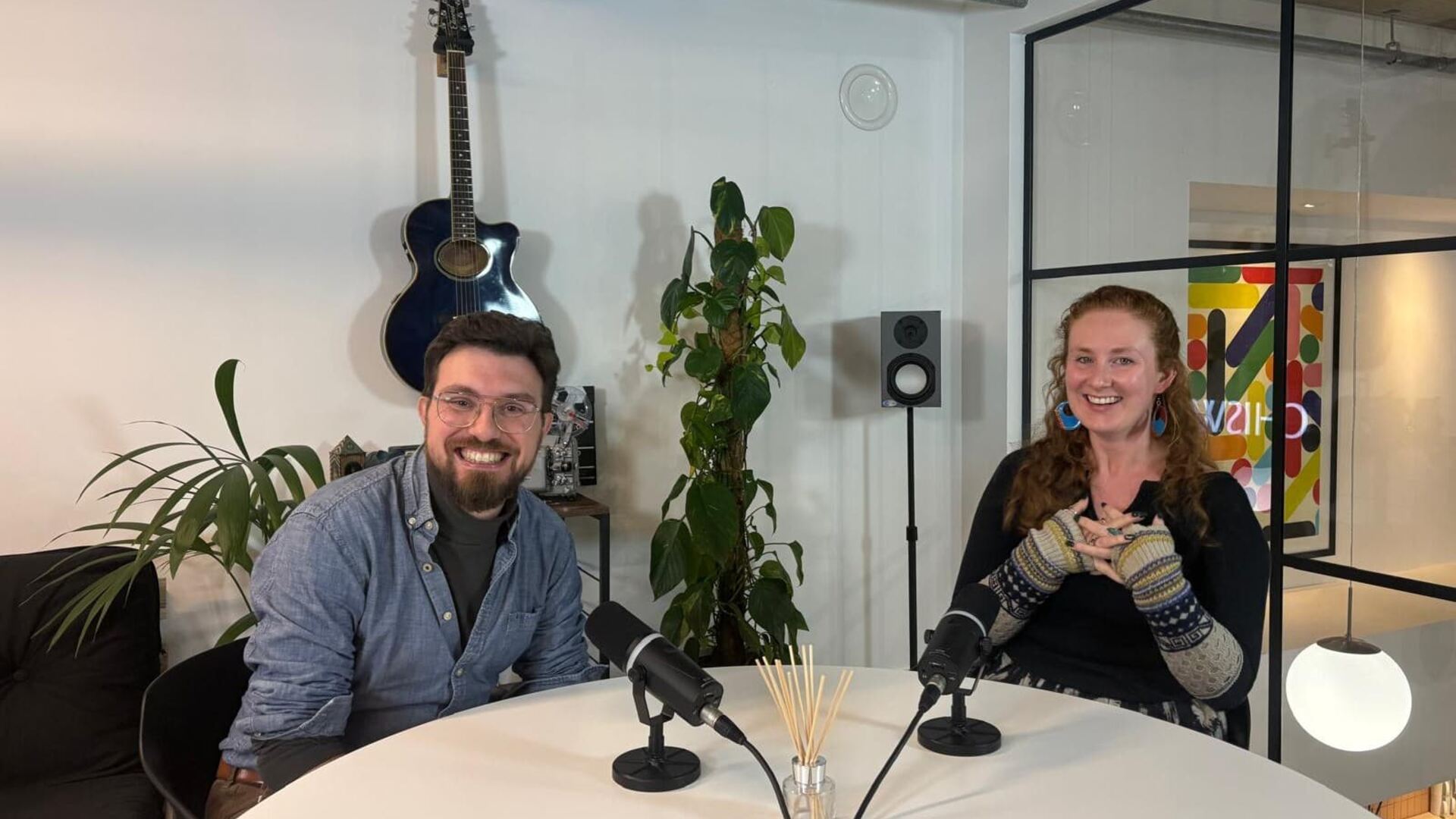
Yoreflix discusses the film 'Strike' with its writer Hendrik Harms.
Strike is a half-hour Victorian ghost story built on one of the most consequential walkouts in British labour history: the 1888 matchwomen's strike in London's East End, where women poisoned by white phosphorus downed tools and won. Its writer, Hendrik Harm, co-directs the Worcester Film Festival and made his first short for £10. Yoreflix founder Imogen Cooper talks to him about phossy jaw, why horror is the best vehicle for an argument, and the line he knew was the line the moment he wrote it.
"If you could go back to any period in history…"
Imogen Cooper: I always start with the same question. If you could go back to any period in history, as yourself or as a character, what would it be?
Hendrik Harm: That's really difficult. I've got two. I've always loved the Victorian era — obviously, that's why I set a film in it. I love the dripping gothic. However, I don't fancy TB.
But my favourite period, the one I've always been fascinated with, is Ancient Egypt. That's where I'd go. I probably wouldn't last long, but I'd go.
IC: People normally stick quite comfortably in the 1900s, maybe the 1800s. I've not had an ancient answer yet.
HH: Where would you go?
IC: The Carolingian era in Western Europe. Charlemagne — that period from the 500s to the 800s, just after the fall of the Roman Empire. So many stories you couldn't make up if you tried. They were up to all sorts of crazy shenanigans.
Why a ghost story, and why this one
IC: Strike is an interesting film partly because of its length — around 30 minutes. What was the inspiration?
HH: I came across Sandstorm, who made the film, through a brief for a competition they were running. They'd set a budget and a script length. As a production company we've been moving towards features, but when I saw it I thought, this is too good to pass up.
I picked this story because I love gothic horror — anything dripping in melancholy, where you can have the long monologues. If you look at something like The Haunting of Hill House, even set in near-present day, it did a really good job of mixing that poetry-feeling dialogue with the visuals. Everyone's getting into the gothic again now — Nosferatu, Frankenstein. You can do a lot with it.
The main reason, though, was that I hadn't seen this story told before. It had come up in side stories, in Enola Holmes and so on, but it had never been the focus of anything I'd seen.
IC: Why horror in particular?
HH: Right now we're in quite a polarised time. Nobody likes being told they should think one way or another. What horror is great for is that you can tell a story with a theme in it and people learn through the theme. If it were a straight modern-day drama they'd feel you were beating them over the head with a stick. But they buy into horror, because it's already a heightened environment.
IC: I have a working theory that any time there's a really polarised feeling in the world, there's a resurgence of the gothic in art and culture.
HH: I like it. I don't need evidence, I'm with you.
IC: You do have Gothic and then Neo-Gothic, and that was a time of great change too. Now everything is rapidly changing and becoming more polarised, and I've seen a big increase in gothic feeling across art, film and TV.
Phossy jaw, and matches used to take lives
IC: Take us back to the matchwomen's strike. What's the history?
HH: It was right here in London. These factories were using white phosphorus to make the matches, which was incredibly poisonous. It gave the women working there phossy jaw — a necrosis that would eat away from the inside and slowly kill them. In the end they went on strike over those conditions.
One of the most interesting things, which I couldn't fit in — it's really hard with a short, because otherwise it starts to sound like a history documentary — is that it was so well known these matches were killing people that people were using them to take their own lives, by eating them. That's how widely understood it was that they were bad.
And the worst of it: red phosphorus had already been created, which was safer, but it was too expensive.
IC: So they put a price on the workers' lives.
HH: It would have cost the factories more. But the fact that it existed at all.
IC: And this was one of the first cases of women going on strike?
HH: In the UK it was the first mass walkout and strike by women. My story sits a little bit adjacent to the history, because I'm very aware I'm not a biopic writer. After the film was finished I talked to the Matchgirls charity — they're looking to have a statue erected in London near where the factories were. It's one of those niche topics where it's about fifty-fifty: either someone says, oh my God, yes, I know that, or they've never heard of it.
Dramatising real deaths in a ghost story
IC: Do you have a balance you adhere to, between how much to dramatise and how much to stick to the facts?
HH: You have to. It's a ghost story, so you're already asking people to suspend disbelief. You then have to anchor it somehow, so you can't lean too far away. Worthing and Gray, the factory in the story, is not a real factory and they were not real people — but it was based on the factories that existed, because there were a few of them around. I wanted that freedom.
The heart of it is the camaraderie between two women. What I wanted was for the ghost not to be the villain, because that's what it usually is in these stories. I wanted the slow burn of the male character, Francine's husband, to be the actual villain — and for him to be a tragic character too, not just a sadist. Something closer to Munchausen by proxy.
It's a delicate balance: a fictionalised person, in a real time period, about real people who died, and it's a ghost story. It's a tightrope.
IC: That's what's clever about historical drama. It's entertainment, but it prompts people to go and educate themselves afterwards. I don't think someone watches a documentary and then feels the need to do their own deep dive — you feel you've been given all the information. With historical drama, people are on Google going, was that true?
HH: Totally agree. And a lot of people just don't like watching documentaries. It's like all art forms — people write off comedy, or animation, because they think it's just for kids. But everyone loved Ripper Street. Everyone loves Peaky Blinders.
The line
IC: What was your favourite part of writing the script?
HH: Actually one of the rewrites. The producer said she wasn't sure the Munchausen by proxy was coming across, and asked me to put something in. And I thought — it isn't going to be named for another hundred years. How on earth do I put this in?
That gave me one of my favourite lines in the script. She's on her own, and she doesn't fall in love. She merely had love inflicted upon her.
When I wrote that I thought, this is it. This is the line.
I was trying to encapsulate the feeling of a person in a time period where something like that wouldn't be taken seriously. There were laws where, if you were married, men could technically still force themselves on their wives up until 1991. So the whole idea of loving someone to death was just so new — especially in that heteronormative relationship, where the man was in control of the situation and that was simply the normal thing.
IC: I'm a self-proclaimed wimp about horror. I famously ran out of Lilo & Stitch at the cinema, screaming. So I'm a good threshold test — if there's a jump scare to be had, I will be jumping. That first one in Strike really did make me jump.
HH: Whenever we did screenings I loved sitting at the back and watching people scream. That's what it was meant to do.
Worcester Film Festival
IC: You co-direct a film festival. A lot of our audience are interested in how to get into the industry, and festivals are a way in.
HH: Worcester Film Festival — lose the "shire". We've just done our fifth year, going into our sixth, and we've recently become BIFA qualifying, which is very exciting. We peg ourselves as a festival for filmmakers and film lovers alike, showcasing films from all over the world, with Midlands categories so we can champion our own area.
What's important is bringing the community together. We have film socials at the end of every day, so that even if you just love watching films you can come and talk about them. We had ten filmmaker Q&As this year, plus networking and pitching events.
Gatekeeping is an interesting thing where we are — we asked ourselves, do people here know how to pitch? So we brought in a pitching specialist for a two-hour workshop, then people go away and get ready for it. This year Worcestershire County Council gave a £1,500 award towards making something in the area.
From a £10 short film
IC: How did you get into the industry yourself?
HH: I started filmmaking about six years ago. Before that I'd tried acting, and I wasn't very good. I had the love of the industry but hadn't found where I fitted — I did a criminology degree, so I wasn't sure where I'd land. I just wanted to be in film. I did background work, which led to getting agents, walk-ons and so on. Then someone put me up for an audition for a bouncer, and I thought, I'm just not that, it's not going to be remotely convincing.
That's when I thought: I really want to write. So I made a short film for £10. It got into one of the BAFTA-qualifying festivals, and that's when I started thinking maybe this is the route.
I've made about eleven short films now. I've won pitch events, done competitions, been optioned. The festival has given me a real insight into the other side of the industry — distribution, exhibition. It started in 2019, and hopefully it's building to a first feature.
IC: Distribution really makes the world go round, but it isn't widely spoken about.
HH: With a short film, the festival route is a lot of your journey and you have to be clever about your strategy. With features, making it is almost the easy part — when you've finished you're about 50% of the way there if you're doing it the indie way, because then you have to work out sales agents, distribution, marketing. There's a massive industry for that, and people widely don't know how it works.
Hendrik Harm's Strike is available to watch on Yoreflix. This interview has been edited for length and clarity.