
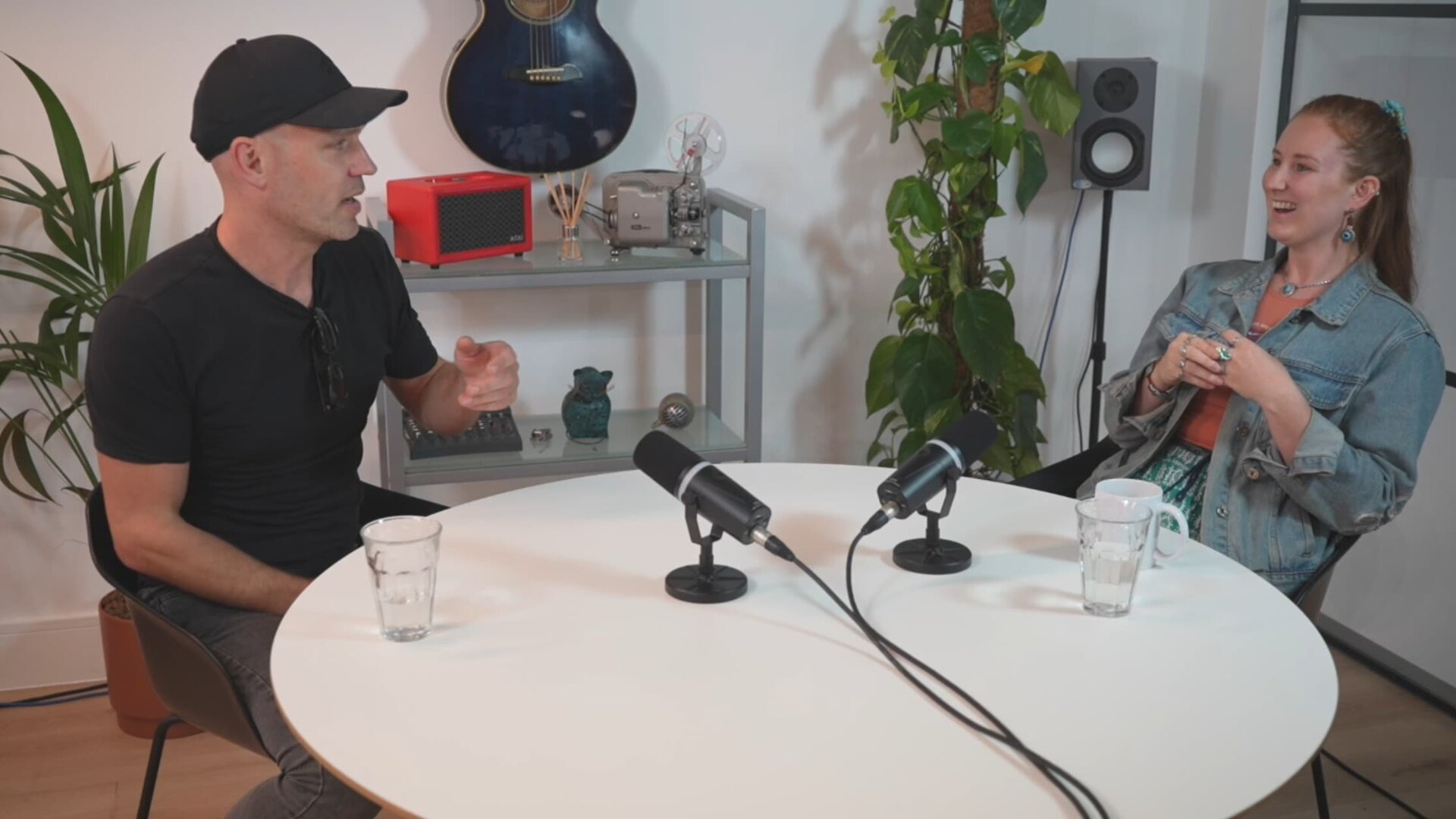
Executive Producer Tom Ward discusses his film 'Strike' and the process of 'making it' in the film industry.
Tom Ward decided at seven that he wanted to be either a filmmaker or the Incredible Hulk. He shot his first film on a three-minute reel of Cine 8 and it came back entirely overexposed. He has now run Sandstorm Films for twenty-five years, funding the films he wants to make out of the visual effects work he happens to be good at — including Strike, which came out of a free screenwriting competition that drew 250 entries. He talks to Yoreflix founder Imogen Cooper about candles with three wicks, twenty copies of every costume, and why period drama is the one thing in the industry that has not changed.
Two people from Bedford
Imogen Cooper: If you could go back to any period, what would it be?
Tom Ward: Strike is set during the Industrial Revolution, essentially, and I'd love to go back then. It would be really interesting to see that London revolution — because I think we're in a revolution at the moment where film is concerned, and that was certainly the first big one in this country.
When you said characters, that made me instantly think of going back thousands of years. But let's not go there.
IC: I'm an ancient history, medieval history girl. That's much more my thing.
TW: Is that how you started all this?
IC: I studied history and English literature and then fell into the film industry. I thought I might do historical research for film and television, and actually got offered a corporate events job — and at the same time a paid internship at a production company. No family in the industry.
TW: Same as me.
IC: We've got quite an affinity here, because it turns out we come from the same town.
TW: Bedford people.
IC: No family in the industry, but family who were very into the arts and film. My mum applied to work at Merchant Ivory and ended up taking over the family business instead. So I was brought up around it.
I said no to the corporate events job. I said I'd take chocolate brownies to a well-known production company in London if they'd let me exist there for a month.
TW: That generally works with production companies, if you offer them free food.
IC: And I spent those four weeks sifting through the CVs of people who wanted the internship I'd managed to land — who were all far more qualified for it than I was. Hundreds of them.
TW: It always catches me out. When we put a job ad out — I did an editor role last year and 600 people applied. And even when we shortlisted to ten, the ten still weren't really good enough, in my opinion.
The problem is our industry, certainly the film side, runs family to family. So it takes a while to integrate yourself into that culture — and into the mindset, because filmmaking is intensive, massive hours. You have to be prepared for that. And we find that the people who apply for jobs aren't always the most qualified, because the most qualified are busy doing things already.
IC: Bedford is a strange place for it, because there isn't a creative industry there.
TW: There was a community video project, which is how I got into it. I was seven when I decided I wanted to start making films.
Seven, and a completely overexposed reel
IC: What part of you as a seven-year-old had that affinity?
TW: I do tell people this, and it's a real story: at seven I wanted to be either a filmmaker or the Incredible Hulk. So you're not that serious at that point.
What caught my imagination was the Tim Burton Batman. And I didn't realise until much later that a lot of it was shot in Bedford — at the Cardington hangars, and in woodland nearby. A lot of the scenery in that film is stuff you don't realise you're looking at. You have an affinity with it, and the affinity is that you actually know the locations.
I liked the darkness and the intensity of it as a kid. It's one of the first films you watch as a child where you think, oh, superhero film, that's going to be great — and actually it's quite dark and quite mature.
Then I realised I couldn't really make films at seven, because I didn't have a camera. So I started doing flick books, and copying Disney films. And a friend of the family said, if you want to animate your stop frames, come on in. That's where it started.
My first stop frame was shot on a Cine 8 camera. And it caught me out, because Cine 8 turns out to be really expensive, and the reels are only three minutes long if you shoot at normal speed — and a seven-year-old doesn't have the money to buy many. So I had one three-minute reel to shoot what was going to be a whole film.
Then they phoned and said it had been developed, come in and have a watch. And pretty much the entire film was overexposed. A complete write-off.
IC: What a great lesson for a seven-year-old in how not to get it wrong again. And a good bit of non-attachment while you're at it.
TW: You go in at the deep end. My own kids have grown up on film sets, because I've had Sandstorm for twenty-five years — I started it as a proper production company when I was eighteen. So they know the etiquette, they know how it works. It's very military. Very quiet on set, everything very focused. They're used to that.
Funding the films you want out of the work you're good at
IC: Strike is a dark story, and you're describing a dark film that caught you as a child. It's tonally consistent.
TW: Very much. Interestingly, most of Sandstorm's work is visual effects production — and if you'd asked the teenage me whether I wanted to do that, I'd have said no. I still feel the same. If I had the option I'd be making noir, dark films, directing them all day long.
But unfortunately I'm quite good at tech. I'm very technical, so visual effects is something I'm just naturally good at. It creates an income for Sandstorm, and that income is what we use to make things like Strike. You have to be able to fund them.
So yes — Strike is exactly the kind of thing I want to be making. And if I could, I'd get hold of an old film camera and shoot something 1930s.
IC: These stories get lost in history. And a lot of the Hans Christian Andersen stories are dark — really dark — and people don't realise, because of how they're adapted.
TW: With Strike, one thing that was tricky is that Sandstorm is quite well known as an approachable visual effects company. When we got the original script I really wanted to take it down a very, very dark route and make it intense — I always feel you're copping out a bit if you don't. But everybody else in the company was going, yes, but what if they think this? So the version you see is quite a friendly version of how we could have interpreted it.
The writer, Hendrik, was very into the subject matter. I didn't know a lot about the suffragette movement and the matchgirls' strike. What got me more excited was the aesthetic.
There's a magic about walking onto a set for a period piece. We're doing one at the moment with a lot of period props, and you walk into the studio and you instantly get that smell — old furniture and leather. Whenever you make a film you want to take the energy of it, not just the light and the imagery but the smell of everything else.
IC: Period pieces are the closest anyone gets to going back in time, because on a set you have to embrace every element of the era.
TW: And haze. You never use as much haze as you do on a period piece.
Twenty of everybody's outfits
TW: Hendrik wrote Strike because Sandstorm was running a screenwriting competition. We started it a couple of years ago — because we're such a technical company, we felt quite strongly that we couldn't write our own films. So we ran a free-to-enter competition, and the winner, we would pay to make the film.
IC: That's gold dust for writers.
TW: It was unbelievably popular. About 100,000 views, a lot of messages, and 250 entries in the end. Some really good stuff — and the ones that performed best were all custom-written for the competition. Strike was custom-written. It was during the SAG-AFTRA strike in the US, and Hendrik said, well, I'm really into Victorian history and the strikes that were happening then, and we're ironically in one now. Very loose parallels. But that's how it happened.
I remember reading his script and thinking it was absolutely brilliant. The only thing that scared me was that it was extraordinarily complicated. And as an executive producer, when you read a complicated script, all you can see is pound signs.
IC: My instinct is dollar signs, because I did more of it in the US.
TW: Period is even more expensive. There was a scene in Strike we had to take out, because it had blood everywhere and we only had the budget for one costume per person. We couldn't get blood on them.
We're doing a set build at the moment, and one of the set builders came up yesterday and said, why have you got so many copies of the wardrobe? We've got twenty of everybody's outfits. And I said — we've got a shooting scene. Someone gets shot, blood goes everywhere. If we need another take from another angle, what are you going to do?
IC: Reset everything.
TW: Years ago I was on set and asked someone why we had fifty of something very minor. He said: because they cost a pound each, and if I have to stop production for two hours while I go and find a candle, that's much more expensive. Times that by every department in the film, and that's where you are.
IC: And the more attention you pay to that at script stage, the easier it gets. If a set-up involves blood, can we avoid changing all the wardrobe again? Can it be a double-up day? We're into the molecular producer side of film here, which I appreciate is probably quite boring.
TW: It's really interesting, though. I'm working on something at the moment that's mostly shot by candlelight. Modern cameras make that easy — Kubrick had to get special lenses.
Do you know what a three-wick candle is? If you're using candles for film you can get different numbers of wicks, which make them brighter. We were genuinely discussing whether to spend the budget on ones, twos or threes. Because a period piece lit on camera looks amazing.
The first period film I went on — I won't name it, but it's very well known — a lot of it was shot by candlelight, and a few of the guys asked why we didn't just fake it with a light and one of those rolly things.
IC: Because it looks rubbish in comparison. You can't beat the real thing. Fake candles are one of my biggest pet peeves, and it's getting trickier as health and safety rules get more stringent — for some good reasons.
TW: I'm not trying to spoil it for you, but there are quite a few fake candles in Strike.
IC: I'm not setting you up.
TW: It's the reset time of a candle. And the fire hazards on location.
"Metrics" — and why period drama hasn't changed
IC: Yoreflix came about because I'm a history student who fell into the industry and ended up executive producing across the UK, the US and Canada — and I was very aware of the rise of these niche genre platforms as a better alternative for people interested in one kind of viewing, rather than paying for all of them.
TW: Really clever idea.
IC: There are platforms for horror, for anime, for documentaries. But there's a huge audience for historical and period drama that spans ages — people interested in history, and people who love film and how history is portrayed.
TW: And it's a wider audience. Horror is taking over at the moment to the point of being oversaturated — but horror is a small audience that's happy to pay, and the films don't cost anything to make, so everyone makes a thousand of them. Some are starting to perform quite badly now. So it's a good time for Yoreflix to come online.
IC: There's an educational element too. Something like Strike is dramatised and scripted, so it's easier to absorb than dry historical fact — but it prompts people to go and look up the matchgirls' strike and the suffragette movement.
TW: When I first read Strike my instant reaction was: get this guy to turn it into a feature. I'd love to talk more about the matchgirls' side of it, and the Industrial Revolution, and give it more breadth. I really wanted to start the film in London. Instead we kept it essentially within one set.
IC: The industry is struggling to prove that anything is worth financing right now. It's all about proof points — how do you justify a feature film over a YouTube series with influencers who have a bigger reach?
TW: We used to shoot a lot of TV commercial work between films, because features take forever. Commercials don't really exist any more, because they're all influencer-led. Every script that lands on my desk is three influencers talking about something.
And what even is an influencer? Someone told me I was one recently, and I said, believe me, I'm definitely not.
IC: It's difficult to justify five million on a period drama when a brand can do a lot with five million and the right people.
TW: But it isn't period drama. It isn't aesthetically pleasing, it isn't cinematic. When you watch a feature you can move things along at a lovely pace and give people something enjoyable to watch. I don't think influencer content and short-form reels are there because people like watching them. I think it's just very addictive.
IC: It's the attention span thing.
TW: I sound like I'm really old. I'm 42. But I started Sandstorm at eighteen, and when you've done something for twenty-five years you've seen a massive evolution.
And interestingly, costume and period drama is one of the only things in my time that hasn't really changed. The only difference on a period set now is that the lights are LED and the camera is generally digital. Other than that it's exactly the same.
Which is quite nice — because the film industry, for all the reasons we've just talked about, is dying. It isn't in a great place. So it's very reassuring to know there's a type of work you can create that's rewarding to make and rewarding for the audience to watch. That's why I was so interested in Yoreflix.
IC: It's about finding the middle ground where you're still generating audience-led data, and can prove engagement for a specific genre. If Strike gets a real surge of views and drives subscription data we can prove, you can go to a distribution partner and say: this is a better bet than a series of short-form content on YouTube.
TW: You can tell she worked in sales.
IC: I did work in sales — but I also strongly believe in it. It's not a pitch.
TW: I love that we're both technically producers, and the moment somebody says "metrics" I'm just trying to stay awake.
IC: We've got to reclaim that. If someone wants metrics, fine, we can give them metrics.
TW: Everybody wants metrics. The question is what they're for. When someone says their fifteen-second YouTube reel got two million views — well, you paid for a million of those. I did a project recently, influencer-led, and as soon as it went live it already had a million views. It's cheating.
Where your platform will be different is that you're looking at metrics for story-led content.
The 1930s
IC: Two questions to wrap up. Those characters from thousands of years ago?
TW: It was slightly comedic and I don't think it's a good idea to talk about it.
IC: That's even more intriguing.
TW: You're not getting it from me today, I'm sorry.
IC: If there were another period you could adapt?
TW: The 1930s, a hundred per cent. Really want to do that. I was doing a project for Ted Baker years ago and we had to take a load of older films — The Maltese Falcon, that kind of thing — and I absolutely fell in love with them. That was around 2001, before it was affordable to make films like that. I thought then that I'd love to do it.
Tom Ward is managing director of Sandstorm Films, which produced Strike, available to watch on Yoreflix. Its writer, Hendrik Harm, appears in another episode of Yoreflix Stories. This interview has been edited for length and clarity.